AC Installation Contract Structures for Multi-Unit Commercial Fit-Outs in Dubai
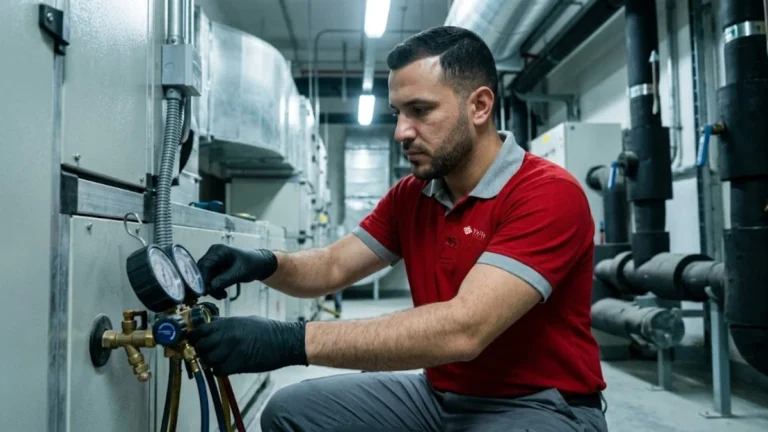
Commercial fit-out projects in Dubai carry AC installation contract decisions that affect cost, timeline, responsibility and operational handover. This guide covers the two installation contract structures commercial clients should understand before procurement, how to decide between them by project size, how to allocate responsibility so risk sits with the right party and how to coordinate DEWA submission and equipment lead times without pushing timeline risk back to the client.
AC Installation Contract Structure, Fit-Out Cost and Responsibility
AC installation during a fit-out means integrating HVAC systems into a commercial interior space while the building is being prepared for occupancy. A fit-out transforms a raw, bare or semi-finished building shell into a functional working environment and AC installation fits into different levels of this process depending on the project stage the fit-out starts from. For the broader context of how installation sits within ongoing property coverage, commercial annual maintenance contracts in Dubai show the service relationship that typically follows installation.
Fit-Out Stages Where AC Installation Fits
Three fit-out stages define where AC installation sits in the overall project. Each stage changes the scope the installation contractor delivers and the cost structure that follows. For the full cost picture across stages, the AC installation cost in Dubai buyer guide covers the cost drivers that scale with stage scope.
- Shell and Core: The building has no internal services or AC. The fit-out contractor designs and installs the entire HVAC network from scratch including ductwork, chillers, air handling units and controls infrastructure. Installation scope is largest at this stage and the cost impact is proportional.
- Category A (Cat A) Fit-Out: The landlord or base-build contractor provides a functional baseline that typically includes basic HVAC units, grid ceilings and main electrical distribution. AC installation at Cat A involves positioning, commissioning or balancing the pre-installed units rather than full new installation.
- Category B (Cat B) Fit-Out: The tenant-specific custom design phase. AC installation involves modifying, relocating or adding ductwork, vents, grilles or split units to match new room partitions, meeting rooms or high-heat zones such as server rooms and data centre spaces.
Key Components of an AC Fit-Out
Three components make up most of the installation labour and determine where responsibility sits during delivery.
- Ductwork and Piping: Routing copper refrigerant lines, drain pipes, supply and return air ducts discreetly above false ceilings or inside wall pelmets.
- Unit Placement: Installing indoor cassettes, ducted units or split AC heads alongside lighting grids, fire sprinkler systems and other MEP services to avoid aesthetic or airflow clashes.
- Integration and Testing: Connecting thermostats, building management systems, pressure testing refrigerant lines, vacuuming the system, balancing airflow and verifying compliance with local building and energy regulations.
How Contract Structure Decides Cost and Responsibility
The contract structure between the client and the installation contractor determines where responsibility sits across these stages and components. Full-service contracts place the whole installation scope under one responsibility line. Scope-split contracts divide the scope across specialist contractors by zone or system type. The choice between them is a function of project size, zone complexity and client procurement capacity rather than contractor preference. Providers unable to speak to contract structure, DEWA ownership and timeline commitments in pre-contract discussion typically create problems these questions should have surfaced earlier. The best HVAC company in Dubai buyer questions guide covers the qualification framework commercial procurement teams use to evaluate installation contractors pre-award.

The 2 Installation Contract Structures for Commercial Fit-Outs
The two structures below cover the practical choices for commercial fit-out AC installation procurement. Each has distinct cost, responsibility and risk characteristics that fit different project types.
Full-Service Installation Contract
What it is: A full-service installation contract places the entire installation scope under one contract with one contractor. The client has one point of responsibility from procurement through to handover. All installation issues route to one contact for resolution.
What work is involved:
- Pre-contract specification review and load calculations
- Equipment coordination with manufacturer or supplier chain
- Ductwork installation and insulation across zones
- Electrical connections including DEWA-certified work
- Controls installation and commissioning
- DEWA submission preparation and approval tracking
- Performance commissioning against specification
- As-built drawings and operations documentation
- Handover package and client training
How Yalla Fix It delivers full-service installation: Every engagement starts with a project assessment covering unit count, zone complexity and timeline constraints before pricing. A single project manager owns the engagement from procurement through handover. Electrical connections are performed by DEWA-certified technicians and submission documentation is prepared to the standard required for approval. Commissioning produces performance test records, as-built drawings and operations documentation suitable for commercial client archives. For clients wanting integrated post-handover coverage, scheduled service follow-up prevents the gap where new installations receive no attention until problems appear.
Related reading: electrical services in Dubai cover the DEWA-certified electrical connection scope that integrates into full-service installation contracts.
Scope-Split Installation Contract
What it is: Scope-split installation contracts divide the work by zone, system type or responsibility area across multiple specialist contractors. Common splits include ductwork infrastructure under one contractor with controls and commissioning under another, split between server room specialist installation and comfort cooling for office areas or split between core shell infrastructure and tenant fit-out installation.
What the trade-off looks like:
- Benefit: Specialist contractors deliver measurably better value in specialist scope areas (server room cooling, data centre precision cooling, high-density office zones)
- Benefit: Better fit for complex multi-use fit-outs where single-contractor capacity cannot cover the whole scope efficiently
- Cost: Multiple contractors mean multiple responsibility lines to coordinate
- Cost: Overlap zones where ductwork crosses contractor boundaries or controls span zones create responsibility disputes when failures occur
- Cost: Interface responsibility between contractors must be documented pre-contract to prevent disputes appearing only after handover
- Cost: Client needs technical procurement capacity to coordinate specialists during installation
When scope-split fits: Large multi-zone fit-outs where single-contractor capacity cannot cover the scope efficiently, mixed-use spaces (office + server room + retail) with distinct cooling requirements and projects where specialist contractors deliver measurable value in specific zones.
How Yalla Fix It operates in scope-split structures: Yalla Fix It handles both positions in a scope-split arrangement. The team can take the lead contractor role coordinating other specialists under one project management structure or deliver a defined specialist scope within a larger multi-contractor fit-out. Interface responsibility with other contractors is documented pre-contract to prevent the overlap disputes that otherwise appear only during occupancy.
Related reading: handyman services in Dubai cover the finish restoration work that integrates after installation across multiple scope areas.
Decision Framework: Which Structure Fits Which Fit-Out
The decision between full-service and scope-split depends primarily on project size, zone complexity and client procurement capacity. The unit-count tiers below show how the structures scale and how Yalla Fix It delivers at each tier.
Under 50 Units: Full-Service
Small fit-outs under 50 units almost always fit full-service contracts. Coordination overhead of running multiple specialist contractors exceeds any procurement savings scope-split would deliver at this size. Yalla Fix It handles these as full-service engagements with a single project manager, a single commissioning workflow and a single handover package. Timeline typically runs 6 to 10 weeks depending on specification complexity and DEWA submission queue. Common examples at this tier are standalone office fit-outs, boutique retail spaces and smaller F and B outlets.
50 to 200 Units: Full-Service by Default, Scope-Split When Zone Complexity Justifies It
Mid-size fit-outs between 50 and 200 units typically still fit full-service unless the fit-out has distinct zone requirements such as a dedicated server room alongside office space, mixed retail and office or a data centre component inside a commercial fit-out. Yalla Fix It handles these as full-service by default with scaled project management capacity and recommends scope-split only when specialist zone requirements justify the coordination overhead. The pre-contract procurement consultation covers zone complexity assessment and produces a structure recommendation matched to the project rather than defaulting to a template.
200+ Units: Scope-Split Becomes Viable, Especially for Mixed-Use
Large fit-outs above 200 units are where scope-split becomes commercially viable, especially for mixed-use projects combining office, retail, server room and data centre zones. Yalla Fix It operates either as the full-service contractor for the whole project where the team’s capacity covers the scope or as a specialist contractor within a scope-split structure led by the main fit-out contractor. Projects at this scale benefit most from pre-contract procurement consultation because the structure decision carries the largest cost and responsibility implications. Facility management services in Dubai cover the integrated coverage capability that large multi-zone fit-outs typically need alongside AC installation delivery.

Responsibility Allocation Reduces Three Specific Risks
Three risks drive how responsibility should be allocated in commercial AC installation contracts. Addressing each one at contract stage prevents the disputes that otherwise appear only after failures occur post-handover.
Risk 1: Install failures with no clear owner. When an installation issue appears after handover, the contract defines who is responsible. Full-service contracts route all installation issues to one contractor. Scope-split contracts route failures to the contractor named for that zone or system. Pre-contract clarification prevents the gap where neither contractor accepts responsibility and the client absorbs the cost. The commercial AMC owner tenant responsibility guide covers how installation responsibility typically hands over to ongoing AMC coverage.
Risk 2: Equipment-side versus installation-side disputes. When a system fails, diagnosis determines whether the cause is equipment-side (routed to manufacturer or supplier) or installation-side (routed to installation contractor). Diagnosis protocol specified in the contract removes the ambiguity that otherwise lets each party point at the other. AC repair and maintenance services in Dubai cover the diagnostic work that typically determines which route a specific failure takes.
Risk 3: Scope-split overlap zones. In scope-split structures, ductwork that crosses contractor boundaries, controls that span scope areas and shared electrical connections create the most common dispute points. Interface responsibility between contractors must be documented pre-contract so each party knows which overlap conditions they own. The AC coil cleaning vs duct cleaning guide covers the scope boundary distinctions that scope-split interface documentation typically needs to address explicitly.
DEWA Submission and Timeline Coordination: Two Rules Reduce Risk
DEWA submission for commercial AC installation requires calculations, documentation and approvals that affect fit-out timeline directly. Two rules at contract stage reduce the timeline risk that otherwise pushes handover slippage onto the client.
Rule 1: Name the DEWA submission owner at contract stage. Full-service contracts place DEWA submission under contractor scope with the contractor’s engineering team producing calculations and documentation. Scope-split contracts need explicit allocation to a named contractor, usually the contractor carrying electrical connection responsibility. Both parties assuming the other handles DEWA submission is the most common cause of approval delay. The AC cleaning service scope and frequency guide covers the commissioning records that complement DEWA submission documentation.
Rule 2: Commit equipment lead times contractually. Equipment lead times for commercial AC can run 8 to 16 weeks depending on specification and manufacturer. Delays in equipment delivery push installation start which pushes commissioning which pushes handover. Specifying lead time commitments in the contract rather than accepting contractor estimates places the delivery risk on the party best able to manage it. The pre-commissioning clean work that typically runs alongside final equipment delivery is covered by AC cleaning services in Dubai rather than consuming specialist installation contractor time.
Choosing an AC Installation Provider in Dubai
Cost for commercial AC installation varies based on measurable factors rather than flat pricing:
- Number of units and total cooling capacity proportional to installation labour and commissioning time
- Installation complexity ductwork design, concealed installations and controls integration affect labour hours
- DEWA submission scope basic compliance versus full engineering submission packages
- Access difficulty multi-floor installations and high-ceiling spaces complicate labour time
- Commissioning depth basic performance test versus full commissioning with as-built drawings
- Post-handover service inclusion scope of ongoing service agreement included with installation
Verify the provider is licensed in Dubai for commercial AC installation and holds DEWA certification for the electrical connections involved. Confirm the provider has specific commercial fit-out experience rather than only residential installation background. Ask about DEWA submission capacity and typical lead times for the specification range. Request references from similar-sized commercial fit-out projects.
Common Commercial AC Installation Contract Mistakes to Avoid
Procurement teams unfamiliar with commercial AC installation contract structures commonly encounter patterns of mistakes that create cost overrun or responsibility disputes.
- Choosing full-service for large multi-zone fit-outs where scope-split specialist contractors would deliver measurably better outcomes in specific zones
- Choosing scope-split for simple single-use fit-outs without accounting for coordination overhead that full-service would absorb
- Not specifying responsibility allocation at contract stage, which creates disputes when failures occur post-handover
- Accepting contractor equipment lead time estimates without contractual commitment, which pushes timeline slippage onto the client
- Skipping DEWA submission ownership specification, which creates approval delay when both parties assume the other handles it
- Using unlicensed installers for electrical connections, which creates safety exposure and compliance issues
- Not planning service access during installation, which makes post-handover maintenance expensive
- Combining AC installation contract with unrelated MEP scope in ways that obscure responsibility for each discipline
How Yalla Fix It Handles Commercial AC Installation
Effective commercial AC installation requires methodology that addresses contract structure, responsibility allocation and DEWA coordination alongside the physical installation.
Pre-Contract Procurement Consultation
Every commercial engagement starts with procurement consultation covering project size assessment, zone complexity review, contract structure recommendation, responsibility allocation planning and DEWA submission ownership. The consultation produces procurement framework recommendation rather than defaulting to standard contract templates.
Contract Structure Flexibility
The team handles both full-service and scope-split structures depending on project fit. Full-service engagements run under single project management with one commissioning workflow. Scope-split engagements run either with the team as lead contractor coordinating other specialists or as a specialist contractor within a larger multi-contractor fit-out.
DEWA-Certified Electrical Work
All electrical connections during installation are performed by DEWA-certified technicians. DEWA submission documentation is prepared to the standard required for approval. Certification credentials are provided on request.
Commissioning and Handover
Commissioning covers performance testing against specification, controls verification, operating documentation and as-built drawing production. Handover produces complete documentation package suitable for both client records and ongoing maintenance planning.
Coverage Integration
For clients wanting integrated coverage across installation and ongoing maintenance, scheduled service follow-up prevents the gap where new installations receive no attention until problems appear.
Why Yalla Fix It for Commercial AC Installation in Dubai
Yalla Fix It has delivered commercial AC installation across Dubai fit-out projects with pre-contract procurement consultation, both full-service and scope-split contract capability, DEWA-certified electrical work and documented commissioning. The team covers 10,000+ maintenance and repair jobs completed across Dubai properties and the technician bench is 75+ certified technicians. Every installation produces documented specifications and handover records suitable for commercial client archives.
Coverage spans commercial fit-out projects across Downtown, Business Bay, DIFC, Dubai Marina, JBR and other Dubai commercial districts.
Book Commercial AC Installation With Yalla Fix It
For procurement teams planning commercial fit-out AC installation, contact Yalla Fix It for a commercial AC installation quote in Dubai and the workflow will be structured around project assessment, contract structure recommendation and documented commissioning.
Frequently Asked Questions
What are the main AC installation contract structures for commercial fit-outs?
Two structures fit most commercial projects. Full-service installation places the whole scope under one contractor for simplified responsibility from procurement through handover. Scope-split installation divides work by zone or system type across specialist contractors with named responsibility per zone.
When should a commercial fit-out use full-service vs scope-split AC installation?
Full-service fits most fit-outs below 200 units and any size project without distinct zone complexity. Scope-split becomes viable for large fit-outs above 200 units and multi-zone projects combining office, server room, retail or data centre spaces where specialist contractors deliver measurably better value in specific zones.
How does responsibility allocation work in commercial AC installation contracts?
Full-service contracts route all installation responsibility to one contractor. Scope-split contracts name a specific contractor per zone or system, with interface responsibility between contractors documented pre-contract to prevent disputes in overlap areas. Diagnosis protocol in the contract separates equipment-side from installation-side failures.
Who handles DEWA submission for commercial AC installation?
Full-service contracts place DEWA submission under contractor scope. Scope-split contracts need explicit allocation to a named contractor, usually the contractor carrying electrical connection responsibility. Specifying DEWA submission ownership at contract stage prevents the approval delay that otherwise occurs when both parties assume the other handles it.
What are typical equipment lead times for commercial AC in Dubai?
Equipment lead times for commercial AC can run 8 to 16 weeks depending on specification and manufacturer. Specifying lead time commitments contractually rather than accepting estimates reduces timeline risk for fit-out schedule.
What documentation should commercial AC installation produce at handover?
DEWA approval documentation, commissioning reports with performance test results, as-built drawings, operating instructions and recommendations for scheduled service. Documentation supports future service history, compliance records and insurance archives.
Does Yalla Fix It handle commercial AC installation across Dubai?
Yes. Commercial AC installation coverage spans Dubai fit-out projects with pre-contract procurement consultation, both full-service and scope-split contract capability, DEWA-certified electrical connections and coordinated commissioning across commercial districts.