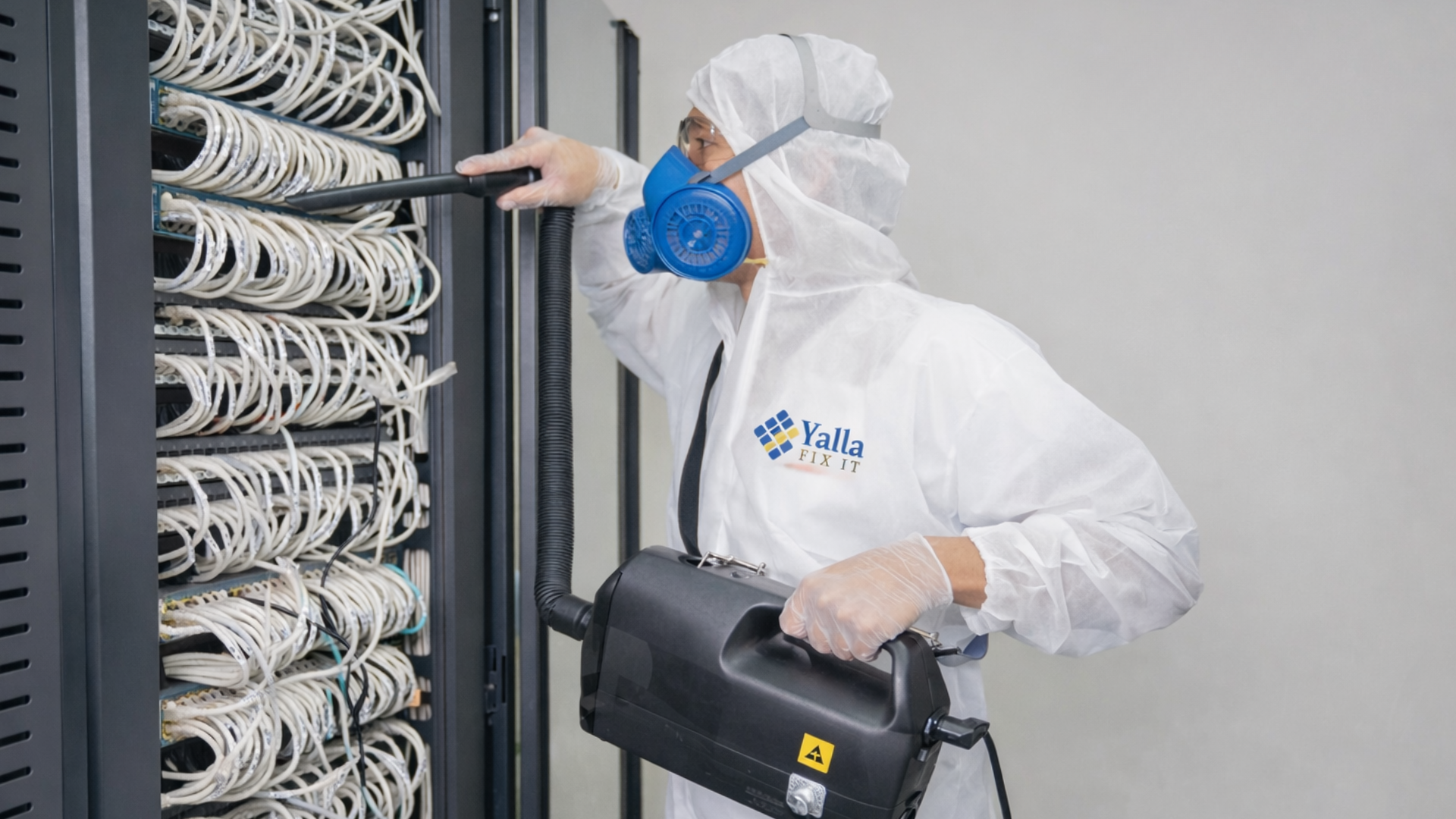
Contamination-related failure is among the top five controllable causes of unplanned data center downtime globally. Most business continuity plans address power redundancy and cyber threats but not the environmental maintenance that prevents the thermal failures and component degradation that trigger BCP events in the first place. Data center cleaning services belong in your BCP as a formal preventive control.
Dubai’s enterprise data centers have made serious investments in resilience over the past decade. Tier III facilities dual power feeds hot-standby DR sites automated failover the infrastructure investment is real and the planning is genuine. And then a dust accumulation event in an underfloor plenum causes a cooling failure that activates the BCP and everyone is surprised.
They shouldn’t be. The Uptime Institute’s annual global survey consistently identifies a category of downtime event that no amount of redundancy planning addresses: failure caused by inadequate facilities maintenance. Not power failure. Not connectivity loss. Not cyber attack. Dust contamination and preventable thermal degradation. The survey data suggests that between 25 and 30 percent of unplanned outages have a facilities maintenance component in their root cause chain.
This article makes the case for treating data center cleaning services as a formal element of your business continuity strategy. For a full overview of what structured data center technical maintenance involves visit our data center cleaning in Dubai service page.
The Contamination-to-Outage Pathway
The pathway from particulate accumulation to BCP activation follows a consistent well-documented progression. It begins with dust accumulating in underfloor plenums on CRAC intake filters and on heat sink surfaces. In Dubai’s desert environment this happens faster than in most global markets and accelerates dramatically during Shamal season. At a threshold point the accumulated contamination begins to degrade airflow delivery to racks. CRAC filters block to the point where the cooling system works harder to push less cold air. Heat sink fins clogged with adhesive UAE silica dust lose their thermal transfer efficiency.
The result is a progressive rise in rack inlet temperatures. In most cases this rise is invisible on DCIM dashboards until it crosses a threshold at which point the thermal alarm triggers and the operations team responds to a symptom not a cause. Under sustained thermal stress hardware fails. The failure may be a PSU, a drive array or a network controller but in each case the root cause is environmental and regular data center cleaning services would have prevented it. Our guide on how data center cleaning enhances performance and longevity covers the performance mechanics of contamination in detail.
Dubai’s contamination risk is elevated above global benchmarks by three specific factors: UAE silica dust is finer and more adhesive than standard urban atmospheric dust bonding to heat sink surfaces rather than settling loosely. The temperature differential between Dubai’s ambient summer environment and the data hall target creates greater condensation risk during humidity fluctuations. And UAE cooling systems run near or at rated capacity for six to eight months of the year meaning a contamination-driven 20 percent reduction in CRAC efficiency during peak summer demand can push a system over its operational limit.
Integrating Data Center Maintenance into Your BCP Framework
The practical integration of data center maintenance into a BCP framework requires three elements: preventive controls, defined monitoring triggers and documentation standards.
As a preventive control the minimum requirement is a structured quarterly maintenance programme aligned to your BCP risk register with one visit specifically scheduled before Shamal season as a storm-exposure mitigation measure. This programme should be named as a formal BCP preventive control with identified responsibility and escalation paths.
Monitoring triggers are equally important. Define the rack inlet temperature variance threshold that triggers an unscheduled maintenance inspection not a BCP activation but a proactive environmental response. Define the DCIM alert pattern that flags potential contamination-driven airflow degradation. Add post-sandstorm events as a mandatory trigger for emergency data center cleaning services engagement.
On documentation: retain all maintenance completion reports particle count data and photo logs in your BCP pack. Include data center maintenance records in annual BCP reviews. For regulated industries, the banking healthcare government ensures your documentation meets the operational resilience standards your regulator requires. Our guide on the challenges in maintaining a clean and efficient data center in Dubai covers the regulatory and compliance dimensions specific to the UAE market.
What Your BCP Needs From a Data Center Cleaning Services Partner
Not all providers are structured to support BCP integration. The specific capabilities you need: a priority response arrangement with a guaranteed attendance time (not a best-efforts commitment); a documentation standard that generates the evidence a BCP audit requires; a zero-downtime operating model so your maintenance programme cannot itself become a BCP event; and an explicit post-storm inspection protocol with confirmed capacity during Shamal season.
This is why we recommend our Annual Maintenance Contract as the foundation of a BCP-aligned programme. The AMC replaces best-efforts arrangements with documented commitments guaranteed response times, regular scheduled visits and a compliance documentation pack that satisfies audit requirements. Our ultimate guide to commercial annual maintenance contracts in Dubai explains how to structure a contract specifically around operational resilience requirements.
Conclusion
A business continuity plan that addresses power and connectivity but ignores contamination management is addressing two of the three main categories of controllable downtime risk. The third is preventable. It is predictable. And unlike a cyber attack or power grid failure it announces itself slowly giving facility managers the opportunity to intervene before it becomes a BCP event if the right maintenance programme is in place.
For the financial case behind scheduled contamination control, our guide to the long-term value of professional data center cleaning provides the evidence base for treating data center maintenance as an investment rather than an operating cost.
Frequently Asked Questions
Should data center maintenance be in our BCP or just our general maintenance schedule?
Both. The maintenance schedule is the operational mechanism for the regular cadence of visits. The BCP integration is the risk framework: the formal recognition of contamination as a continuity risk, the defined triggers for emergency response and the documentation standards required for audit. Both need to exist and cross-reference each other.
Our BCP focuses on power and connectivity redundancy. Is contamination really a comparable risk?
In terms of frequency yes. Power and connectivity failures in Dubai’s modern data center infrastructure are relatively rare precisely because significant investment has been made in resilience. Contamination-driven thermal degradation is a constant progressive risk that affects every facility; the difference is that power failures are dramatic and visible while contamination failure is gradual and easy to misattribute.
How should we budget for data center maintenance within our BCP framework?
An Annual Maintenance Contract with a fixed scope and price enables the cost to appear as a predictable line item in operational budgets rather than a variable reactive spend. Compare the AMC cost against the average hourly downtime cost for your facility for most UAE enterprise data centers the calculation closes within a single prevented incident.
