Signs Your AC Needs Gas Refilling (And Why Ignoring It Costs More)
Dubai AC systems run at high load for most of the year and refrigerant issues progress faster here than in temperate climates. Recognising the signs early prevents the biggest cost trap in AC maintenance: compressor damage from running on inadequate refrigerant. This guide covers the eight signs an AC needs gas refilling, why ignoring them costs multiples more than early intervention, the right way to handle refilling and how to select a provider that fixes root causes rather than repeating temporary refills.
Why AC Gas Refilling Signs Matter in Dubai
Refrigerant, sometimes called AC gas, is the working fluid that absorbs heat from indoor air and releases it outside. The system is designed as a sealed loop; refrigerant should never need topping up over normal operational life. When levels drop, it means there is a leak somewhere in the refrigerant lines, connections, coils or compressor seals.
Dubai’s operating environment accelerates leak development. Continuous high-temperature operation causes thermal cycling that stresses joints and seals. Coastal humidity accelerates corrosion on outdoor components. Vibration from constant operation loosens fittings over time. What might be a minor pinhole leak in a cooler climate becomes a persistent refrigerant loss under Dubai conditions.
The consequences of running on low refrigerant compound quickly. The compressor works harder to move insufficient refrigerant through the cycle. The evaporator coil freezes because of reduced heat absorption. Electricity consumption rises significantly for the same cooling output. Eventually, the compressor overheats or seizes and compressor replacement typically costs many times what leak repair and proper refill would have cost. Understanding this cost curve is what makes early sign recognition valuable.
The 8 Signs Your AC Needs Gas Refilling
The signs below appear in rough order of how early they typically show up. Catching the first signs saves the most cost.
1. Warm or Weak Air From the Vents
The clearest sign of low refrigerant is air from the vents that feels warmer than it should or has noticeably weaker flow. The AC may still be running but the cooling capacity has dropped. In Dubai summer, this presents as rooms taking much longer to reach comfortable temperature or never quite getting there.
2. Longer Cooling Times Without Reaching Set Temperature
An AC with adequate refrigerant should reach the thermostat setting within a reasonable time and then cycle off. When refrigerant is low, the unit runs continuously trying to reach the set temperature and often never does. This continuous running is one of the earliest measurable symptoms.
3. Higher Electricity Bills for the Same Usage
When cooling capacity drops but the AC keeps running to compensate, electricity consumption rises substantially. A DEWA bill jumping significantly month over month with no change in usage pattern often traces back to a refrigerant issue rather than tariff changes. Reducing AC electricity bill in Dubai summer through 12 targeted fixes covers what to check when consumption jumps unexpectedly.
4. Ice Buildup on Refrigerant Lines or Evaporator Coil
Low refrigerant causes the evaporator coil temperature to drop below freezing during operation. Condensation on the coil then turns to ice, which blocks airflow completely. The visible sign is ice on the copper refrigerant lines running to the outdoor unit or ice visible on the indoor evaporator coil when the front panel is opened. Once ice forms, the AC must be switched off and allowed to thaw fully before running again and the underlying refrigerant issue must be addressed or the freeze recurs immediately.
5. Hissing or Bubbling Sounds Near the Unit
Active refrigerant leaks sometimes produce audible hissing (small gas escape) or bubbling (liquid refrigerant escape) sounds near the connection points, coils or lines. These sounds are diagnostic; they indicate the leak location as well as its existence. Any unusual sound from a running AC unit warrants investigation.
6. Water Leaks Around the Indoor Unit
When the evaporator coil freezes and then thaws, the melt water often exceeds what the condensate drain can handle. Water leaks around the indoor unit or dripping from the base of the wall-mounted unit frequently trace back to a freeze-thaw cycle caused by low refrigerant rather than drain blockage alone.
7. Compressor Running Constantly Without Cooling
In extreme cases, the outdoor unit runs continuously (compressor and fan on) but no cool air reaches the interior. This indicates severe refrigerant depletion where the system cannot complete the cooling cycle at all. At this stage, damage to the compressor may already be occurring and immediate professional attention is required.
8. AC Cycling On and Off Rapidly
Rapid on-off cycling, sometimes called short cycling, can also indicate low refrigerant among other causes. The compressor starts, cannot build proper pressure, safety controls shut it down and it restarts moments later. This cycling wears components rapidly and creates electrical stress that can cause capacitor and contactor failure alongside the underlying refrigerant issue.
Why Ignoring These Signs Costs More
The temptation with early symptoms is to defer action until convenient. In Dubai’s operating environment, this deferral is expensive.
Running on low refrigerant forces the compressor to work under conditions it was not designed for. Heat that should be absorbed by refrigerant instead builds in the compressor itself. Metal components expand beyond tolerance. Compressor oil breaks down. Internal seals degrade. Eventually the compressor either seizes mechanically or fails electrically and compressor replacement typically costs many times what leak repair plus proper refill would have cost. In many cases with older units, the compressor failure makes the entire outdoor unit uneconomic to repair, forcing full unit replacement.
Alongside the compressor cost, low-refrigerant operation drives electricity consumption significantly higher for the same cooling output. Over a Dubai summer, the accumulated DEWA overspend can itself exceed the cost of proper leak diagnosis and repair. The AC also delivers reduced cooling comfort throughout the period, which has its own cost in occupant wellbeing and building content protection (electronics, artwork, medications).
Insurance and warranty implications add another layer. Manufacturer warranty typically requires that faults be addressed promptly through licensed service; continued operation with known faults can void warranty coverage. Home insurance claims for consequential damage (mould from prolonged high humidity, electronics failure from heat) may be complicated if the underlying AC issue was known and not addressed.
The Right Way to Handle AC Gas Refilling
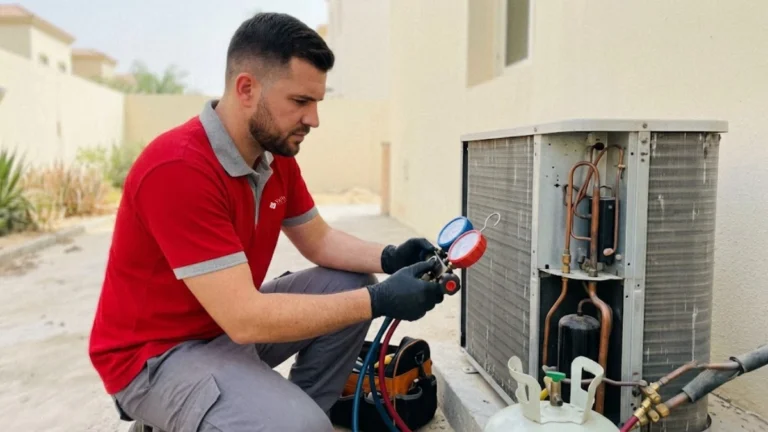
Proper AC gas refilling in Dubai always follows the same sequence: diagnose the symptoms, locate the leak, repair the leak, then refill with the correct refrigerant to specified levels. Skipping the leak repair step is where most short-term refilling money is wasted.
Leak detection typically uses electronic leak detectors that respond to refrigerant traces at leak points or UV dye added to the refrigerant that reveals leak locations under UV light after the system has run. Both methods require licensed technician access to the system.
Once the leak is located, repair depends on the location. Line leaks can often be repaired at the joint or by section replacement. Coil leaks (evaporator or condenser) sometimes require coil replacement. Compressor seal leaks may require compressor service. Fitting leaks are typically the fastest and lowest-cost to address, which is why early detection matters so much.
After repair, the system is vacuum-tested to confirm the leak is sealed, then refilled with the specific refrigerant type (R32, R410A or older R22) to manufacturer specification. Overfilling causes almost as many problems as underfilling, so proper measurement matters. AC repair and maintenance services in Dubai include leak detection, repair and proper refill as an integrated service rather than refill alone.
Choosing an AC Gas Refilling Provider in Dubai
Cost for AC gas refilling in Dubai varies based on measurable factors rather than flat pricing:
- Refrigerant type, R32, R410A and legacy R22 have different refrigerant costs
- Refrigerant quantity required, larger systems need more refrigerant
- Leak location and repair complexity, accessible joint leaks are lower-cost than coil replacement
- Diagnostic method, some leaks require dye and follow-up visit, adding to total scope
- Emergency vs scheduled response, peak-season emergency response carries urgency premium
- Unit age and condition, older units may require multiple issues addressed together
Providers offering “gas top-up” as a standalone service without leak diagnosis are the ones to avoid. This is where cost multiplies over time as the same refill happens repeatedly without solving the underlying issue.
Verify the provider is licensed in Dubai for AC work and DEWA-certified for electrical components. Confirm technicians have refrigerant handling qualifications (refrigerant is a regulated substance). Ask for written diagnosis identifying leak location before refill authorisation. Request warranty on both the leak repair and the refill. Providers unwilling to provide these standard elements typically deliver short-term refills that mask ongoing problems.
Common AC Gas Refilling Failures to Avoid
Property occupants and operators unfamiliar with proper practice commonly encounter patterns of mistakes that create recurring costs. Accepting gas top-up without leak repair means the same failure returns within weeks. Choosing lowest-price providers who skip leak diagnosis extends the cost trap. DIY refill attempts void warranty coverage and create real safety risk (refrigerant can cause burns and refrigerants are regulated substances). Ignoring early symptoms allows compressor damage to accumulate. Using unlicensed technicians for refrigerant work creates liability exposure. Not documenting the refill amount and refrigerant type makes future service more complex. Skipping the vacuum test after leak repair means air and moisture contaminate the refrigerant, damaging the system from within.
For occupants trying to understand what proper AC service actually includes, the difference between coil cleaning and duct cleaning is a useful reference because coil condition directly affects refrigerant efficiency and system pressure.
How Yalla Fix It Handles AC Gas Refilling
Effective AC gas refilling requires methodology that addresses root cause rather than symptoms.
Leak Detection Before Refill
Every gas refilling call starts with leak detection using electronic detectors or UV dye methods. Refill without leak repair is not offered as a service because it wastes the customer’s money on repeated visits for the same issue.
Licensed Refrigerant Handling
All refrigerant work is performed by qualified technicians using proper recovery, evacuation and charging equipment. Refrigerants are handled as regulated substances rather than casual top-ups.
Full System Assessment
Alongside the refrigerant work, the AC is assessed for related issues that may have developed from operation on low refrigerant, including coil condition, compressor operation, electrical components and airflow. Related issues get identified for immediate or scheduled attention.
Documentation and Warranty
Every refilling job produces a written diagnosis identifying leak location, scope of repair completed, refrigerant type and quantity, vacuum test results and warranty terms. Standard six-month warranty covers both the leak repair and the refill.
Coverage Integration
For occupants and property managers wanting to prevent refrigerant issues rather than react to them, scheduled AC service within an AC maintenance contract in Dubai includes periodic refrigerant level checks that catch developing leaks before symptoms appear. Related AC scope including coil cleaning and duct inspection reduces the stress on refrigerant systems that accelerates leak development. AC cleaning services in Dubai address coil condition and AC duct cleaning services in Dubai address airflow issues that force refrigerant systems to work harder.
Different AC configurations have different refrigerant behaviour and understanding split ducted and VRF differences in Dubai villas helps set the right maintenance expectations for the specific installation.
Why Yalla Fix It for AC Gas Refilling in Dubai
Yalla Fix It has delivered AC repair and refrigerant service across Dubai residential and commercial properties with leak-detection-first methodology, DEWA-certified electrical work and 24/7 emergency response for cooling failures. The team covers 10,000+ maintenance and repair jobs completed and the technician bench is 75+ certified technicians. Every refrigerant service includes leak detection and repair rather than top-up alone and standard six-month warranty covers both the repair and the refill.
Coverage spans residential and commercial properties across Downtown, Business Bay, DIFC, Dubai Marina, JBR, Jumeirah, Arabian Ranches and other Dubai neighbourhoods, with emergency response typically arriving within 30 minutes of confirmation during peak season.
Book AC Gas Refilling With Yalla Fix It
For occupants noticing signs of low AC refrigerant, contact Yalla Fix It for AC gas refilling in Dubai and diagnosis will identify the leak location before any refill work begins.
Frequently Asked Questions
What are the signs my AC needs gas refilling in Dubai?
The main signs are warm or weak air from vents, longer cooling times, higher electricity bills, ice on refrigerant lines, hissing or bubbling sounds, water leaks around the indoor unit and a compressor running constantly without cooling. Any of these signs warrants professional diagnosis.
How often does AC gas need refilling?
Never, under normal conditions. Refrigerant is a sealed system that should not need topping up. If refilling is needed, it means there is a leak that must be located and repaired.
Can I refill AC gas myself?
No. Refrigerant is a regulated substance requiring licensed handling, DIY refill voids manufacturer warranty and refills without leak repair mean the problem returns within weeks. Professional licensed service is required.
How much does AC gas refilling cost in Dubai?
Cost depends on refrigerant type, quantity, leak location and repair complexity. Written diagnosis before authorisation is standard practice. Providers quoting refill without leak diagnosis are typically not delivering complete service.
What happens if I ignore signs of low refrigerant?
Compressor damage accumulates from running on low refrigerant and compressor replacement typically costs many times what leak repair plus proper refill would have cost. Electricity consumption also rises significantly during the period of low refrigerant operation.
How is an AC refrigerant leak located?
Licensed technicians use electronic leak detectors that respond to refrigerant traces at leak points or UV dye added to the refrigerant that reveals leak locations under UV light. Both methods require professional equipment.
Does Yalla Fix It handle AC gas refilling across Dubai?
Yes. AC refrigerant service coverage spans residential and commercial properties across Dubai with leak-detection-first repair, DEWA-certified technicians, 6-month warranty on repairs and 24/7 emergency response for cooling failures.