AC Coil Cleaning Dubai: The Most Important AC Service You Are Probably Skipping
Quick Answer: AC coil cleaning is the single highest-impact AC maintenance service in Dubai. Dirty evaporator and condenser coils reduce cooling efficiency by 20 to 40 percent, force compressors to work harder and fail sooner and directly cause the majority of avoidable AC breakdowns in Dubai properties. A filter change is not a coil clean. Most Dubai AC service visits that don’t explicitly include coil cleaning are leaving the most important part of the service undone. |
Most Dubai residents and property managers believe they are getting their AC properly serviced. They have a technician visiting once or twice a year. The filter gets changed. The remote is checked. The unit cools. Everything seems fine.
The part they are almost certainly not getting is a coil clean. And the coil is the component that determines almost everything about AC efficiency, running cost and compressor lifespan. In Dubai’s climate where AC systems run at close to maximum load for five to six months of the year dirty coils are the single most common cause of avoidable AC failure, elevated electricity bills and premature compressor replacement.
This guide explains why AC coil cleaning is the service that matters most in Dubai’s climate, what it involves and what you should be asking for when you book an AC service. For a full overview of our AC coil cleaning service, visit our AC coil cleaning services in Dubai page.
Evaporator Coil vs Condenser Coil: Two Different Cleaning Requirements
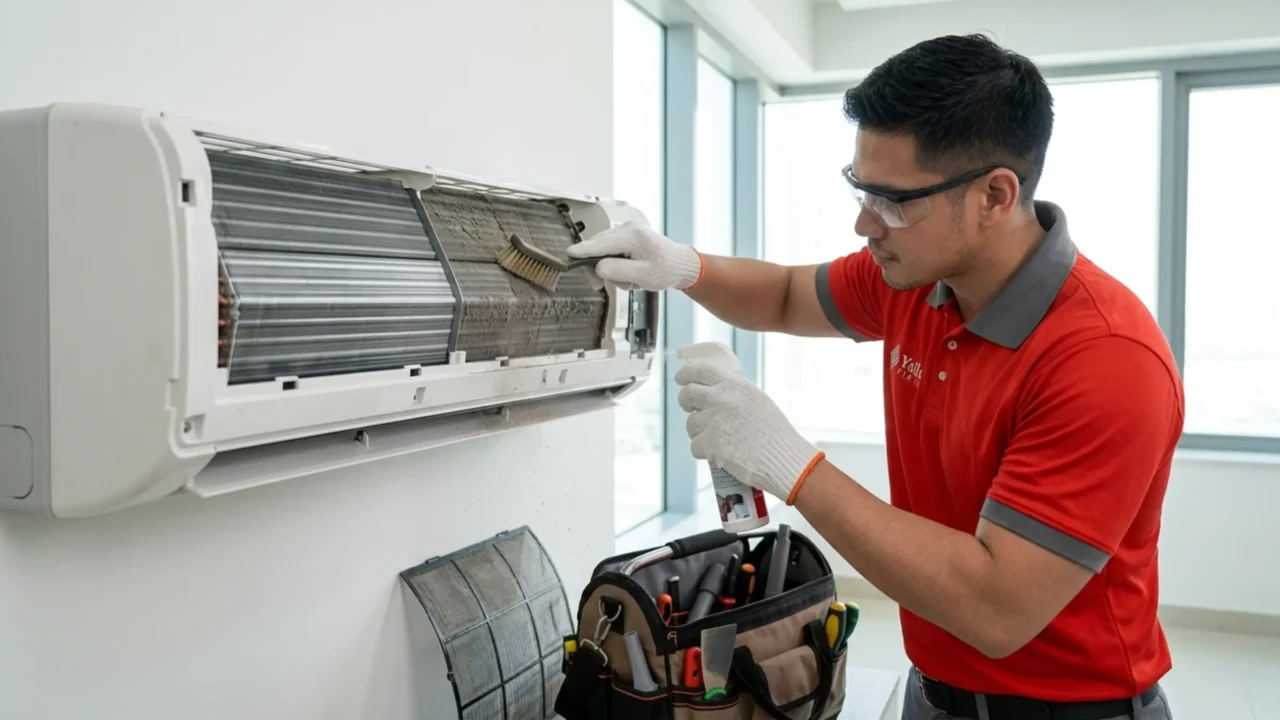
A split AC system has two coil units, each with a different role, a different location and a different contamination profile.
The Evaporator Coil
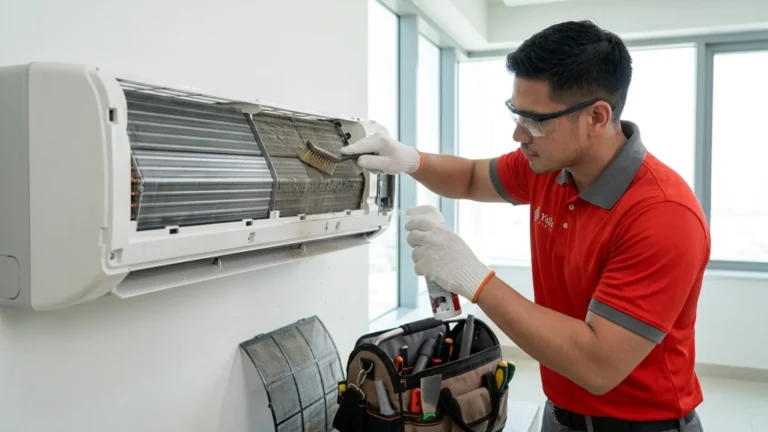
The evaporator coil sits inside the indoor unit. It is the component that absorbs heat from your room air and transfers it to the refrigerant circuit. Because it handles the air you breathe and because air from Dubai interiors carries fine dust, pet hair, skin cells and in many properties mold spores, the evaporator coil accumulates biological contamination alongside mechanical fouling. A dirty evaporator coil impedes heat transfer, reduces airflow through the indoor unit and in Dubai’s humid summer conditions, creates ideal conditions for mold growth directly on the coil fins.
Evaporator coil cleaning is necessarily a detail-oriented process; the fins are densely packed, the coil sits in an enclosed indoor unit and improper cleaning can bend fins and reduce airflow permanently. Professional coil cleaning uses specific coil cleaning chemicals applied with appropriate dwell times, then carefully flushed through the condensate drainage system.
The Condenser Coil
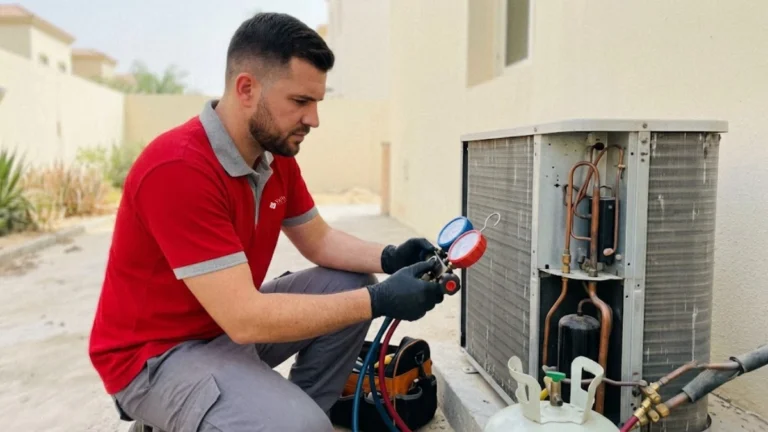
The codenser coil sits in the outdoor unit. It releases the heat absorbed from inside the building into the ambient outside air. In Dubai, the outdoor unit is exposed directly to one of the most contaminating environments on earth for mechanical equipment: abrasive silica sand and dust carried in Shamal winds, which accumulates between condenser fins and progressively blocks the airflow that the condenser needs to dissipate heat.
A blocked condenser coil cannot release heat efficiently. The refrigerant circuit pressure rises. The compressor operates outside its designed parameters. In a Dubai summer with outdoor temperatures above 45°C a badly fouled condenser coil is a compressor replacement waiting to happen. Condenser coil cleaning in Dubai requires specific tools to reach between densely packed fins without damaging them and it needs to happen before summer, not after the first breakdown.
What Dirty Coils Actually Do to Your AC System
The efficiency impact of dirty coils is not subtle. Laboratory testing and field data from service records consistently shows that a coil with a 0.1mm layer of fouling less than the thickness of a human hair reduces heat transfer efficiency by between 20 and 30 percent. In practical terms for a Dubai property:
- A 2.5kW AC unit effectively becomes a 1.75kW to 2kW unit requiring longer running cycles to reach the same temperature.
- The compressor runs longer per cooling cycle, under higher thermal stress, accelerating wear that manifests as a 30 to 40 percent reduction in compressor lifespan over a 5-year period.
- Electricity consumption increases by 20 to 40 percent for the same cooling output, a material cost impact in a Dubai villa or commercial space with 10 or more AC units.
- In severe cases, blocked condenser coils cause the compressor to trip on high-pressure protection repeatedly; the AC cuts out on hot days precisely when it is most needed.
None of this appears as an alarm or an error code. The AC cools, just inefficiently and at rising cost, until it doesn’t. Our ultimate guide to AC repair and maintenance services in Dubai explains the full spectrum of AC maintenance services and how they relate to each other in a properly structured annual programme.
What a Professional AC Coil Clean Involves
Evaporator Coil Cleaning
Access requires removing the indoor unit’s front panel and filter. The coil is inspected for contamination type and extent. A pH-appropriate coil cleaning chemical is applied to the coil fins and allowed to dwell agitating biological contamination and chemical fouling from the fin surfaces. The coil is then carefully flushed, with the cleaning solution and contamination draining through the condensate drainage system. Critically, the drain pan and drain line are also cleaned as part of the same process. A blocked drain line from a clean coil is the most common cause of water ingress in the weeks after an AC service.
Condenser Coil Cleaning
The outdoor unit cover is removed. Compacted sand and dust is removed from the condenser coil fins using a combination of soft-bristle brush work and controlled pressure cleaning appropriate for the fin gauge. Any bent fins are straightened using a fin comb. The outdoor unit’s drainage is checked and cleared. The cleaned coil is inspected before reassembly to verify fin clearance and contamination removal.
Post-Clean Verification
After both coils are cleaned, the system is run and monitored for temperature differential across the evaporator coil (a measure of heat transfer efficiency), outlet temperature and refrigerant pressure if gauges are used. These readings verify that the cleaning has restored the system to operating parameters.
How Often Should Coils Be Cleaned in Dubai?
The right frequency depends on the specific environment, but Dubai’s climate demands more frequent attention than most global benchmarks suggest. As a general guide:
- Residential properties (apartments): Evaporator coil cleaning at least once per year, ideally before summer. Condenser coil cleaning before summer is essential given Shamal season contamination.
- Villas with rooftop condensers: Condenser cleaning twice per year before summer and after Shamal season (typically late April/early May and October/November).
- Commercial and hospitality properties with high occupancy: Both coils twice per year at minimum. High-traffic commercial properties accumulate contamination faster than residential.
- Industrial and dusty environments: Quarterly for condenser coils is not excessive in proximity to construction, desert, or heavy industrial activity.
A properly structured annual maintenance contract includes scheduled coil cleaning at appropriate frequencies for your property type.
Conclusion
In Dubai’s climate, AC coil cleaning is not a maintenance nice-to-have. It is the core of any genuine AC maintenance programme. A filter change without a coil clean is the maintenance equivalent of changing your car’s air filter but never servicing the engine; it addresses the visible and accessible component while leaving the critical one untouched.
The cost of a professional coil clean is a small fraction of the compressor replacement it prevents and a smaller fraction still of the cumulative electricity cost of operating fouled coils through a Dubai summer. For a broader understanding of why skipping annual AC maintenance in Dubai is a false economy, our guide on why skipping annual home maintenance in Dubai is a bad idea sets out the financial case in full.
Frequently Asked Questions
How do I know if my coils have been cleaned in previous service visits?
Ask the technician to show you the coil before and after cleaning. A properly cleaned evaporator coil is visibly different from a dirty one; the aluminium fins are bright and clear rather than grey or brown. If a service visit didn’t involve removing the indoor unit panel and accessing the coil directly, the coil was not cleaned. Filter replacement and coil cleaning are different procedures.
Can dirty coils cause mold in my AC system?
Yes. The evaporator coil operates at temperatures and humidity levels that support mold growth when contamination is present. The combination of organic material (dust, skin cells) and moisture on the coil surface creates ideal mold conditions. This is why evaporator coil cleaning often produces a notable improvement in indoor air quality; the biological contamination on the coil is removed.
My AC is still cooling well. Do I still need coil cleaning?
The system cooling well and the system operating efficiently are not the same thing. A unit with fouled coils cools, it just costs more, runs longer cycles and accumulates compressor wear faster. The efficiency degradation from dirty coils is gradual and invisible until either the electricity bill is compared or the compressor fails. The right moment to clean coils is before efficiency degrades noticeably, not after.
How much does AC coil cleaning cost in Dubai?
The cost of AC coil cleaning in Dubai varies depending on the type of unit and accessibility. On average, prices range from AED 150 to AED 400 per unit. More complex systems or heavily contaminated coils may cost more due to additional labour and cleaning requirements.
Does AC coil cleaning reduce electricity bills?
Yes. Clean coils improve heat transfer efficiency, allowing the AC system to cool faster and run for shorter cycles. This can reduce electricity consumption significantly, especially during Dubai’s peak summer months.
What happens if AC coils are not cleaned regularly?
If coils are not cleaned, dust and debris build up, reducing cooling efficiency and increasing strain on the compressor. Over time, this can lead to higher energy costs, poor cooling performance, and potential system breakdowns.