Dubai’s property market moves fast. Off-plan units are sold years before completion. Secondary market transactions close in days. And somewhere in the middle of both a building inspection is either the step that protects a buyer’s investment or the step that gets skipped because there’s pressure to get a handover.
That skip is expensive. According to multiple property snagging companies operating in Dubai 70 percent of newly completed properties in the UAE have some form of identifiable defect at handover. Most of those defects are the developer’s legal responsibility to fix. Most of them are only identified if someone with the right tools and methodology actually looks for them before the keys change hands.
This guide explains what a building inspection in Dubai actually covers, how it fits into Dubai’s property regulatory framework and what the difference is between a building inspection and the more specific term you’ll encounter when buying new property. Our property snagging service in Dubai page sets out what a professional pre-handover inspection involves.
What Is a Building Inspection in Dubai?
A building inspection is a systematic professional evaluation of a property’s condition. Depending on the context of new-build purchase, resale acquisition, end of tenancy or commercial acquisition the scope and framing differ but the core activity is the same: a qualified inspector assesses every accessible element of the property documents findings and produces a report that the client can act on.
In Dubai’s residential property market the term ‘building inspection’ most commonly arises in three contexts. The first is pre-handover inspection of a new-build or off-plan property where the inspection is specifically about identifying defects before the buyer accepts legal ownership from the developer. The second is a pre-purchase inspection of a secondary market property where the buyer wants an independent condition assessment before committing to a resale transaction. The third is an end-of-tenancy or condition survey typically commissioned by a landlord or outgoing tenant to document the property’s state at a point in time.
Each of these three contexts has a different legal framework, a different scope emphasis and a different consequence for the findings. The pre-handover context is the most time-sensitive and the one with the clearest legal teeth which is why it has its own specific name in Dubai’s property market: property snagging.
Building Inspection vs Property Snagging What’s the Difference?
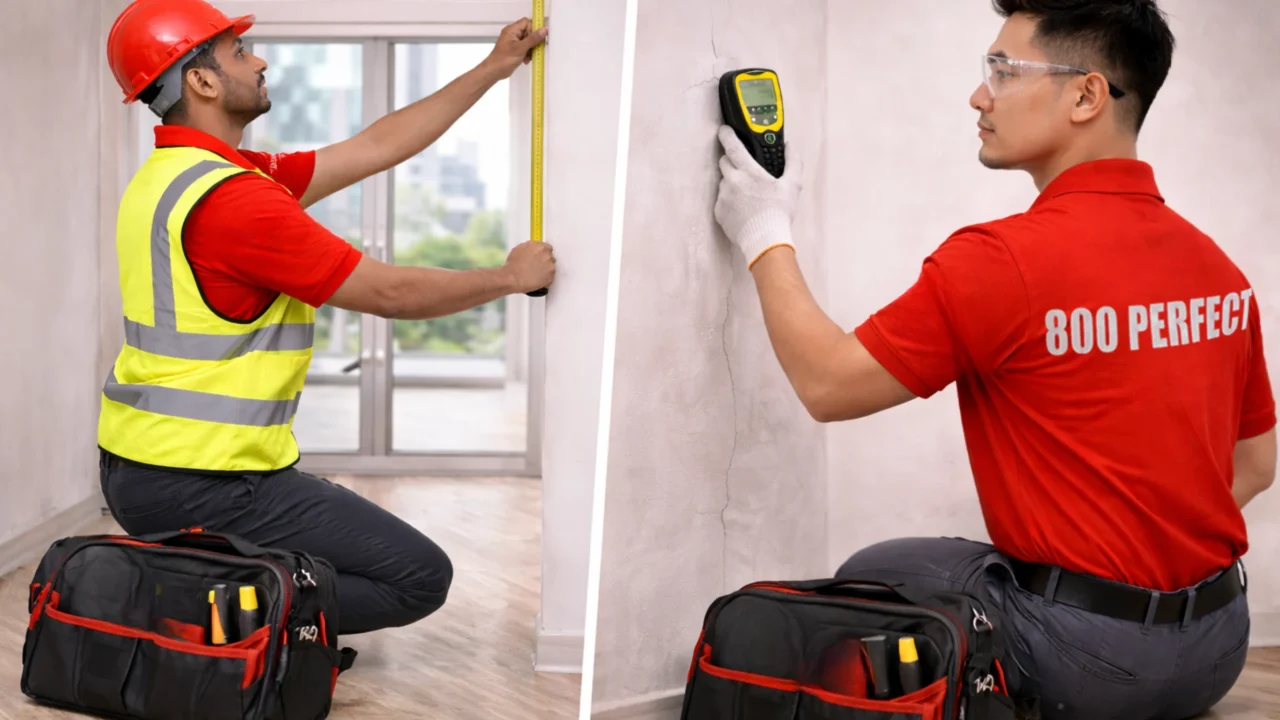
The distinction matters practically. Property snagging is a pre-handover building inspection conducted on a newly built or recently completed property specifically designed to identify defects against a build specification and document them as the developer’s legal liability under the Defect Liability Period.
A building inspection in the broader sense is the right description for condition assessments on secondary market properties, resale units, older buildings and commercial premises where the relevant legal framework is the sale contract rather than the developer’s statutory DLP obligations.
The tools overlap thermal imaging moisture meters, socket testers and visual inspection are used in both contexts. The legal consequences are different. After a snagging inspection the developer must fix identified DLP-covered defects at no cost to the buyer. After a building inspection on a resale property the findings inform a negotiation; the outcome depends on what the seller is willing to address.
For a full explanation of how these two services differ and which one applies to your specific situation, our ultimate guide to property snagging in Dubai covers the legal framework, the inspection process and what happens after the report is delivered.
What a Building Inspection Covers in Dubai
Structural and Civil Elements
All wall floor and ceiling surfaces are checked for cracks, voids delamination and out-of-level conditions. Structural concerns are noted separately from cosmetic findings; both are significant but carry different implications for the developer’s liability and the urgency of remediation.
MEP Systems Mechanical Electrical and Plumbing
Every socket in the property is tested for correct wiring earthing continuity and function. All taps, mixers and sanitary fixtures are checked for flow temperature seals and drainage. AC units are run under load to verify cooling performance, condensate drainage and remote function. The distribution board is checked for MCB labelling accuracy and trip function. In a new-build context non-commissioned systems smoke detectors fitted but not connected fire door closers installed but not adjusted are among the highest-priority findings.
For a more detailed assessment of wiring safety and performance, professional inspectors often rely on professional electrical services in Dubai to ensure all systems meet safety standards.
Finishes and Fixtures
Tiling is checked for hollow spots alignment and grout consistency across all tiled surfaces of the bathroom kitchen and floor. Paint and plaster surfaces are assessed for roller marks, uneven coverage and adhesion. Joinery cabinetry and built-in furniture are checked for alignment soft-close function and hardware quality. Sanitaryware is inspected for installation standard and physical condition.
Technology-Assisted Checks
Professional building inspections in Dubai include thermal imaging for concealed moisture and insulation voids moisture meter readings in all wet areas and socket testing with an earth continuity function. These three tools identify the defects most commonly missed by visual-only inspections and they are the categories that account for the highest-value remediation findings. Our guide to smart tools and what they catch in property snagging explains what each technology detects and why it matters.
The Legal Framework: Why a Building Inspection at Handover Is Not Optional

Under Article 40 of Law No. 6 of 2019 Dubai developers carry structural defect liability for 10 years from the issuance of the completion certificate and non-structural defect liability for a minimum of one year from handover. These are statutory obligations that do not require the buyer to have booked a professional inspection to exist in principle.
What a professional inspection does is provide the documented evidence required to enforce them. A buyer who accepts handover moves in and discovers a waterproofing failure three months later has a significantly harder legal position than a buyer who documented the same waterproofing failure before handover in a dated photographed inspection report submitted to the developer on day one of the DLP window.
The Defect Liability Period clock starts at handover. The defects you document before that moment are the developer’s problem. The defects you discover after the window has passed are yours.
Choosing a Building Inspection Provider in Dubai
For new-build and off-plan properties the single most important capability to verify in any inspection provider is whether they include thermal imaging as standard. Thermal imaging is not an optional extra in Dubai’s climate; it is the primary tool for detecting the most expensive defect category (waterproofing failures and insulation voids) before they manifest as visible damage.
Beyond equipment look for: a structured 200-plus point inspection methodology rather than an ad hoc walkthrough; photographic documentation for every finding; a written report delivered within 24 hours; and RERA-submission ready format in case developer engagement requires escalation. For the full set of factors to consider when evaluating property maintenance and inspection services in Dubai our guide to choosing property maintenance services in Dubai provides the evaluation framework.
Conclusion
In Dubai’s fast-moving property market the building inspection is the single step that most directly determines whether a buyer’s investment is protected from day one or whether they’re absorbing defect repair costs that were legally someone else’s responsibility. For new-build and off-plan buyers that step has a name, a specific legal framework and a specific deadline: property snagging conducted before handover within the Defect Liability Period.
The gap between a documented inspection before handover and a defect discovered six months later is not just a matter of convenience. It is the difference between a developer-funded repair and an owner-funded one.
Understanding how this process works in practice and what a complete inspection involves can be explored further through property snagging and inspection services in Dubai.
Frequently Asked Questions
When is the right time to book a building inspection in Dubai?
For new-build and off-plan properties: before you accept handover ideally in the 48 to 72 hours before your scheduled handover appointment. If you have already accepted the handover book as soon as possible within the Defect Liability Period. For resale properties: before you sign a sale and purchase agreement.
Does the developer have to fix everything the inspection finds?
Defects that fall within the statutory DLP scope structural issues for 10 years non-structural for a minimum of one year must be rectified at no cost to the buyer. A professionally documented snagging or building inspection report is the evidence base for compelling that rectification. Items outside the DLP scope are subject to negotiation.
Can I do a building inspection myself?
You can conduct a structured visual walkthrough and doing so before a professional inspection is worthwhile. What you cannot replicate without specialist equipment is the thermal imaging moisture metering and socket testing that identifies the highest-value defects that are invisible to the naked eye. For high-value properties the cost of a professional inspection is a fraction of a single missed defect.
What is the difference between a building inspection and a property valuation?
A property valuation assesses market value of what the property is worth. A building inspection assesses physical condition, what is wrong with it and what needs to be fixed. They are different services provided by different professionals for different purposes. Both are relevant in a property transaction but only a building inspection identifies defects for remediation purposes.
How long does a property inspection take?
The duration depends on the size, layout, and complexity of the property. A professional inspection is not time-limited but process-driven, ensuring every accessible element is assessed in detail using both visual checks and specialized tools.
What happens after the inspection report is submitted?
The report is formally shared with the developer or seller as a documented record of defects. A rectification plan is then confirmed, followed by completion of the works. A re inspection is conducted to verify that all identified issues have been resolved to the required standard.
Is a building inspection necessary for new properties?
Yes, newly completed properties frequently have defects at handover. A professional inspection ensures these are identified, documented, and submitted within the Defect Liability Period, making them the developer’s responsibility rather than the buyer’s.
