Zinc whiskers are one of the most under-recognised failure modes in older Dubai data centers. It is the only operational discipline that catches them before they damage hardware. The whiskers are tiny, conductive, hidden inside the under-floor plenum and almost impossible to detect without specialist data center cleaning services and diagnostic equipment. The damage they cause looks like ordinary hardware failure: intermittent server reboots, switch port faults, premature PSU loss, distributed network glitches. IT teams replace the failing equipment, the contamination source remains, replacement equipment fails again. The cycle continues until someone runs a proper deep-clean assessment that identifies zinc whiskers as the root cause. The data center deep cleaning service from Yalla Fix It includes zinc whisker assessment as part of every standard scope on older Dubai facilities.
This guide covers what zinc whiskers are, how they form, why older Dubai facilities carry the highest risk, how to identify contamination, the data center cleaning services protocol used for mitigation and the six-step programme for running mitigation cleanly. The Yalla Fix It team has run zinc whisker assessments and remediation across enterprise on-premises rooms, colocation halls and managed service operations across data center cleaning Dubai engagements with the methodology refined for the local building stock.
What Zinc Whiskers Are and Why Data Center Deep Cleaning Catches Them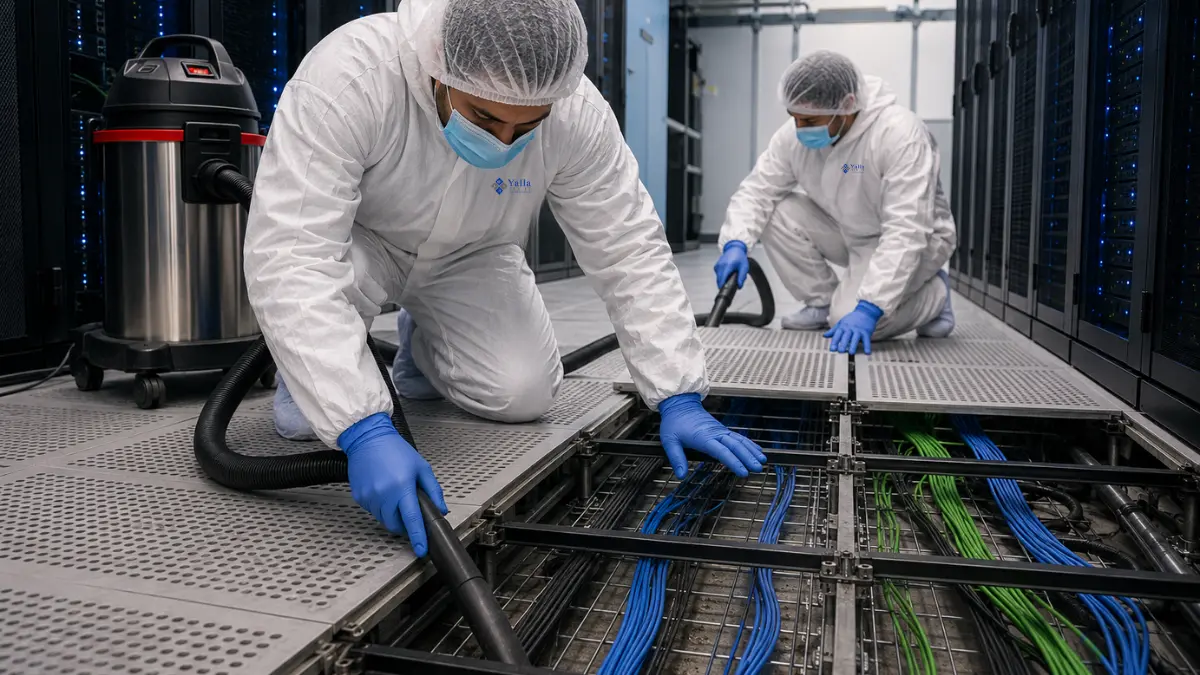
Zinc whiskers are crystalline filaments of pure zinc that grow spontaneously on electroplated zinc surfaces over years. The filaments are typically 1 to 5 micrometres in diameter and can grow to 1 to 10 millimetres in length. These filaments accumulate undetected. The growth mechanism is linked to internal stress in the plating, environmental humidity cycling and contact with certain alloying elements. The whiskers are conductive, brittle and easily dislodged by mechanical disturbance or sustained airflow.
Inside a data center, the most common source is the underside of older raised access floor tiles. The steel substrate of raised floor tiles is routinely zinc-electroplated for corrosion protection. Over a 5 to 20 year window the zinc plating ages, whiskers grow and the under-floor plenum becomes a slow-release raised floor contamination source that only this discipline can address. Other sources include older equipment rack frames, cable tray brackets, cable management hardware and miscellaneous zinc-plated fittings.
Once airborne, whiskers circulate through the under-floor plenum and reach equipment intakes through perforated tiles or cabinet airflow paths. Newer raised floor systems use alternative coatings or non-electroplated finishes that are not whisker-prone. The wider context on cleaning protocols is set out in the ultimate guide to data center cleaning, which covers the ISO 14644-1 framework and contamination control protocols across the full scope.
Why Older Dubai Data Centers Need Specialist Data Center Deep Cleaning
Dubai enterprise on-premises rooms and colocation halls carry a distinctive zinc whisker risk profile that demands specialist cleaning. Six factors combine to elevate the risk above typical international baselines.
Building Stock Age: Many enterprise data rooms in older Dubai office towers were commissioned in the 2000s and early 2010s with raised access floor systems that are now 12 to 20 years old. That window is well inside the typical zinc whisker growth period. Without routine assessment, contamination accumulates undetected. Colocation halls in older Dubai facilities carry the same age profile.
Sustained Cooling Load: Dubai data centers operate under continuous cooling load year-round. The CRAC and CRAH units run at high duty cycle, driving sustained high airflow through the under-floor plenum. High airflow accelerates whisker dislodgement once growth has occurred, which is why scheduled cleaning matters so much in this climate.
Shamal Season Dust Profile: Seasonal Shamal events deliver fine abrasive dust that can penetrate building envelopes and reach the under-floor plenum. The mechanical impact of dust loading can fragment whisker tips and push them into circulation. A robust cleaning programme accounts for the seasonal cadence shift.
Humidity Cycling: Dubai external humidity profile drives the cooling system hard against the indoor humidity setpoint. Tight humidity control is the right protocol but it does not eliminate the long-term effect of humidity cycling on zinc plating aging. Only the right cleaning cadence catches the whiskers before they fragment.
Equipment Refresh Disturbance: Hardware moves, rack additions and cable routing under-floor disturb the plenum mechanically. Each disturbance dislodges loose whiskers into circulation. Routine assessment after any major hardware move is operational best practice.
Compliance Reporting Gaps: Operators running facilities without formal data centre contamination control programmes do not run baseline zinc whisker assessments. The data centre contamination accumulates undetected until equipment failures surface as a pattern that triggers investigation.
How Zinc Whiskers Damage Hardware Without Data Center Deep Cleaning
The operational impact of zinc whisker contamination is severe and routinely misdiagnosed because the failure signature looks like ordinary hardware failure. Whiskers landing across PCB traces, connector pins or component leads cause momentary short circuits that trigger reboots, parity errors or hardware faults. Without intervention to remove the contamination source, the fault clears when the whisker burns out or shifts, leaving no permanent evidence.
Power supplies are particularly exposed. Whiskers entering server PSUs cause overcurrent trips, capacitor failures or full PSU loss. Replacement PSUs fail quickly because the cleaning required to remove the contamination has not been run. Top-of-rack switches, core switches and storage controllers experience port failures, line-card resets and inexplicable performance degradation. The fault pattern is distributed across the data hall rather than localised to a single rack, which is one of the strongest signals that the root cause is environmental rather than equipment-specific and demands intervention.
CRAC and CRAH cooling units are also affected. Whiskers reaching the cooling control electronics affect humidity sensors, temperature probes and damper actuators. Cooling control behaviour becomes erratic with no obvious mechanical cause. Equipment lifecycle is shortened across the board: hardware that should run 5 to 7 years experiences accelerated failure rates because of repeated micro-shorts. Replacement cost is significant and the warranty case is often disputed because the contamination source is not visible to the equipment vendor unless documented records exist.
The compliance dimension matters too. Operators running ISO 27001, ISO 14644-1 or vendor-specific contamination thresholds face audit findings if data centre contamination is identified during third-party inspection. Remediation cost rises sharply once the contamination is documented in an external audit report. The wider context on contamination risk and data center deep cleaning safety protocols is covered in the ESD safety guide for data center deep cleaning.
How Data Center Cleaning Detects Zinc Whisker Contamination
Zinc whisker assessment is a specialist exercise. Visual inspection alone does not work because the whiskers are below the threshold of unaided vision. The standard assessment process runs through five stages.
Stage one: raised floor tile sampling. A representative selection of floor tiles is lifted, the underside is photographed at low magnification and sample swabs are taken from the steel structure. Stage two: microscope analysis. Swabs are examined under stereo microscope and where required electron microscope to confirm whisker presence, length distribution and density. Stage three: air handling pathway evaluation. The under-floor plenum, CRAC return air path and equipment intake filters are inspected for whisker accumulation as part of the workflow. Stage four: contamination level classification. Findings are graded against ISO 14644-1 cleanliness classes and operator-specific contamination thresholds. Stage five: report generation with recommended grade.
The output is a contamination assessment report. Whisker presence yes or no. Whisker length distribution and density. Floor tile age and plating condition. Under-floor plenum contamination level. Recommended programme scaled to severity. The Yalla Fix It data center deep cleaning team produces the assessment report inside 5 to 7 working days of inspection completion. The audit framework that integrates with this assessment is set out in the data center cleaning audit checklist.
The Data Center Deep Cleaning Protocol for Zinc Whisker Mitigation
Severity scales with contamination level. Light whisker presence with no fragmentation evidence runs a maintenance-grade programme. Moderate contamination with active fragmentation runs a remediation-grade programme. Severe contamination with documented equipment failures runs a full replacement programme. The Yalla Fix It framework runs four stages calibrated to the appropriate severity grade.
Stage one is containment. The affected area is isolated, traffic restricted, mechanical disturbance minimised and HEPA-filtered negative pressure established where required. Stage two is under-floor cleaning. The plenum is cleaned with HEPA-filtered vacuum extraction and surface-bonding cleaning agents that fix loose whiskers in place rather than redistributing them. Stage three is floor tile remediation or replacement. Affected tiles are sealed with a coating that bonds whiskers to the steel structure or replaced with non-whisker-prone tiles where contamination is severe. Stage four is ongoing scheduled monitoring. The cleaning service file is updated with whisker monitoring as a recurring item, with re-inspection at 6 to 12 month intervals.
The Yalla Fix It data center deep cleaning team carries the diagnostic toolkit, cleaning equipment and remediation supplies for all four stages and runs the programme as a single engagement rather than a sequence of separate visits. The contamination assessment outputs flow directly into the mitigation plan with no handover gap. The recurring data center deep cleaning protocol after mitigation is set out in the data center cleaning checklist for Dubai facilities.
How to Run a Cleaning Programme for Zinc Whisker Control
Six steps run a credible zinc whisker mitigation programme inside the broader data center deep cleaning scope on a Dubai facility. The framework applies to enterprise on-premises rooms, colocation halls and managed service operations.
- Commission a data center deep cleaning contamination assessment with floor tile sampling, microscope analysis and air handling pathway evaluation.
- Receive the contamination assessment report inside 5 to 7 working days with severity classification and recommended data center deep cleaning grade.
- Run the appropriate data center deep cleaning grade with HEPA vacuum extraction, surface-bonding agents and floor tile sealing or replacement based on severity.
- Update the cleaning service file with zinc whisker monitoring as a recurring inspection line item on a 6 to 12 month cadence.
- Coordinate floor tile replacement with planned hardware refresh windows to minimise operational disruption during intervention.
- Document the data center deep cleaning programme in the compliance pack so future audits show contamination control as an active operational discipline.
Operators running all six steps maintain effective zinc whisker control across the asset lifecycle through disciplined contamination control. The Yalla Fix It data center deep cleaning team runs assessment, remediation and ongoing monitoring under one account team with the contamination control framework documented at compliance grade. The wider best practice context is covered in the 25 data center cleaning best practices resource.
The Bottom Line on Zinc Whiskers and Deep Cleaning
Zinc whiskers are a real and high-impact contamination risk in older Dubai data centers, particularly facilities running raised access floor systems above 10 years old. The failure signature is misdiagnosed routinely because the symptoms look like ordinary hardware failure. Data center deep cleaning is the only operational discipline that catches the contamination source. Mitigation requires HEPA vacuum extraction, surface-bonding cleaning agents, targeted floor tile remediation or replacement and an ongoing monitoring discipline.
Yalla Fix It runs zinc whisker assessments, remediation programmes and ongoing monitoring across Dubai data centers. The team carries the specialist diagnostic tooling, cleaning equipment and remediation supplies for all four mitigation stages, with the contamination assessment flowing directly into the mitigation plan under one engagement.
To commission a zinc whisker contamination assessment or set up an ongoing programme for a Dubai facility, contact the Yalla Fix It team. The team will scope the engagement against the facility age, floor tile profile and operational sensitivity, share a transparent line-item proposal and confirm the booking inside one working day.
Frequently Asked Questions
What does data center deep cleaning include for zinc whisker control in Dubai?
Data center deep cleaning for zinc whisker control includes raised floor tile sampling, microscope analysis, air handling pathway evaluation, HEPA-filtered vacuum extraction, surface-bonding cleaning agents and floor tile sealing or replacement. The Yalla Fix It data center deep cleaning team runs all four mitigation stages under one engagement.
How does data center deep cleaning detect zinc whiskers in older Dubai facilities?
Data center deep cleaning detects zinc whiskers through floor tile sampling at low magnification, swab analysis under stereo and electron microscope, under-floor plenum inspection, CRAC return air path evaluation and equipment intake filter examination. Visual inspection alone does not work because whiskers are below the threshold of unaided vision.
Why is data center deep cleaning especially important for older Dubai data centers?
Older Dubai data centers carry the highest zinc whisker risk because raised floor systems commissioned in the 2000s and early 2010s are now well inside the typical 10 to 20 year zinc whisker growth window. Data center deep cleaning is the only operational discipline that catches the contamination before it damages hardware.
How often should data center deep cleaning run on a Dubai facility with zinc whisker risk?
A baseline data center deep cleaning assessment is recommended on commissioning of any new contract. Re-inspection runs at 6 to 12 month intervals depending on the contamination level identified at baseline and the facility age. The Yalla Fix It data center deep cleaning service file embeds the inspection cadence as a recurring item.
Does data center deep cleaning for zinc whiskers require a Dubai facility shutdown?
Containment and under-floor data center deep cleaning is typically run in live conditions with appropriate area isolation. Floor tile replacement at scale may require coordination with planned hardware moves. Most Dubai data center deep cleaning mitigation programmes run without a full shutdown.
What does the Yalla Fix It data center deep cleaning team document for compliance audits?
Per-visit service reports, monthly compliance summaries and an annual compliance pack covering ISO 14644-1 cleanliness verification, ESD protocol logs, zinc whisker monitoring records and HEPA filtration evidence. The Yalla Fix It data center deep cleaning programme is documented at compliance grade with audit-ready reporting.
Should newer Dubai data centers schedule data center deep cleaning for zinc whiskers?
Newer raised access floor tiles use alternative coatings that are not whisker-prone, so the early-year risk is significantly lower. Even so, scheduled data center deep cleaning at the right cadence remains best practice because the risk profile rises after 8 to 10 years of operation. The Yalla Fix It data center deep cleaning team builds zinc whisker monitoring into long-term cleaning service files.
