If you’ve booked a coil cleaning service and noticed your DEWA bill did not drop the way it should have, or your cooling did not improve as expected, the reason is often that the service cleaned only one coil when both needed attention, or applied generic chemistry when specialised chemistry was needed. AC systems have two coils that do different jobs and accumulate different contamination types. Understanding which coil to clean, when, and with what chemistry is what separates professional aircon coil cleaner service from generic AC maintenance. This guide walks through what an aircon coil cleaner actually is, how to identify which coil needs service, and where to book AC cleaning services in Dubai that clean the right coil the right way.
Why AC Systems Have Two Coils and Why This Matters
Understanding the two-coil structure of an AC system is essential to understanding why cleaning matters and why cleaning the wrong one wastes money.
The Evaporator Coil: Indoor Cooling Interface
The evaporator coil sits inside your indoor AC unit. It handles two jobs: absorbing heat from air blown across its surface, and condensing moisture out of that air as it cools. The refrigerant flowing through the copper tubing evaporates as it absorbs heat, which is how cooling actually happens.
The evaporator coil is where cooling capacity is delivered. When it accumulates contamination, cooling performance drops immediately.
The Condenser Coil: Outdoor Heat Rejection Interface
The condenser coil sits inside your outdoor AC unit. It handles the reverse job: rejecting the heat absorbed by the evaporator into the outdoor environment. The refrigerant that evaporated indoors condenses back to liquid form here as it releases heat to outdoor air blown across its surface.
The condenser coil is where the system’s heat rejection efficiency is set. When it accumulates contamination, the compressor has to work harder to overcome the reduced heat rejection.
Why the Distinction Matters for Cleaning
The two coils accumulate different contamination types. Evaporator coils accumulate dust, condensation-related residue, mould, and biological material. Condenser coils accumulate dust, salt (in coastal Dubai), organic material, and heat-baked contamination from continuous outdoor exposure.
Cleaning only the evaporator when the condenser is loaded, or the reverse, addresses only half the efficiency loss. This is the most common way that aircon coil cleaning services underdeliver on DEWA bill savings.
The Two Contamination Profiles: What Loads Each Coil
Different Dubai property types load evaporator and condenser coils differently.
What Loads the Evaporator Coil
Evaporator coils face contamination from indoor air blown across their surface: dust that bypasses filters, biological material (mould, bacteria) that thrives in continuous condensate, condensation residue over time, cooking grease in kitchen-adjacent systems, and skin cells and pet dander in occupied spaces.
For a Dubai apartment or villa, evaporator coil contamination is typically dust plus biological growth, with additional grease loading in properties with open kitchens.
What Loads the Condenser Coil
Condenser coils face contamination from outdoor air blown across their surface: airborne dust from Dubai’s construction and desert environment, salt residue in coastal properties (Marina, Palm Jumeirah, Al Mamzar), organic material like pollen and plant debris, urban pollution particulate from vehicle traffic, and heat-baked residue from continuous outdoor operation at high temperatures.
For a Dubai property, condenser coil contamination is typically dust plus location-specific additional loading (salt for coastal, industrial dust for warehouse zones like Al Quoz).
Why Both Coils Usually Need Attention
For most Dubai properties, both coils accumulate contamination simultaneously across the same operating period, though at different rates. The evaporator loads faster in kitchen-adjacent commercial and continuously occupied residential. The condenser loads faster in coastal properties, industrial zones, and older buildings with restricted outdoor airflow.
Professional service that only cleans one coil when both need cleaning is common and it consistently underdelivers on the outcomes property owners actually want.
What a Professional Aircon Coil Cleaner Service Actually Does
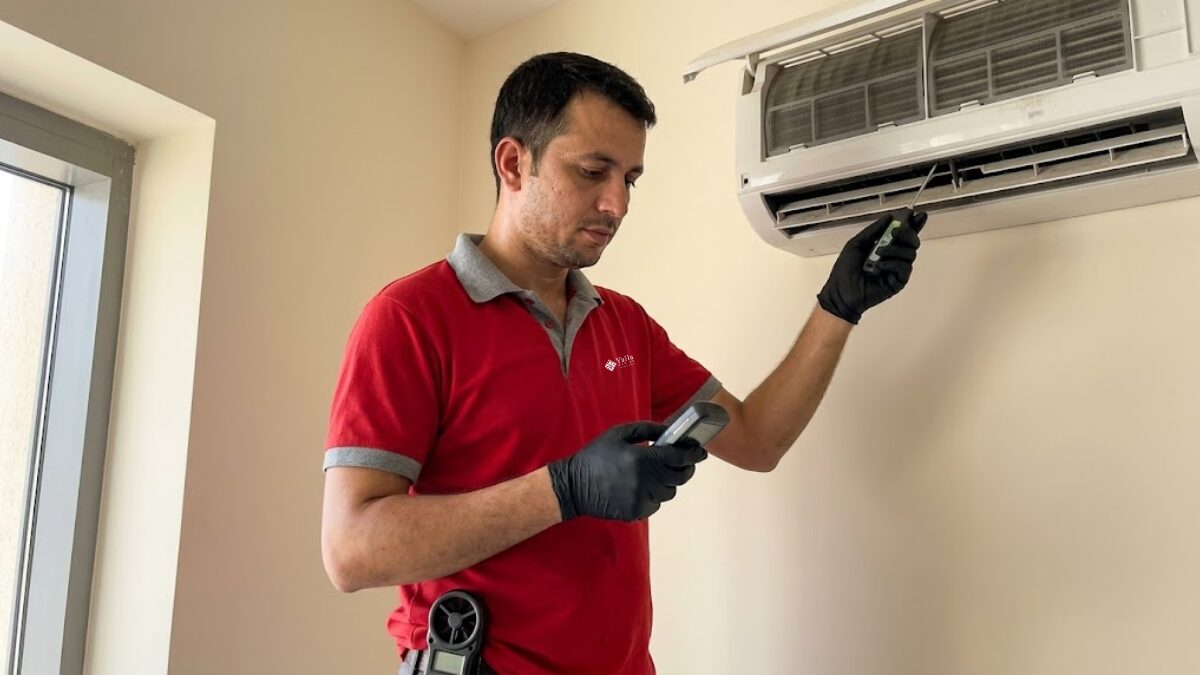
Professional coil cleaning service is different from a filter swap or a surface wipe. A full service follows NADCA-adherent standards and covers both coils properly.
Pre-Service Assessment
Cooling output, airflow across the evaporator, and temperature differential measured before any work begins. This baseline identifies which coil is contributing to efficiency loss and shapes the cleaning scope.
Evaporator Coil Cleaning Process
Indoor unit powered down and tagged out. Covers, filters, and blower assemblies removed to access the evaporator coil. Dry vacuum removes surface dust before wet cleaning. Non-acidic chemical cleaner applied and left 10 minutes to dissolve accumulated grime without damaging aluminium fins. Controlled rinse with drain-pan containment. Dubai Municipality-approved bio-sanitisation applied to eliminate mould and bacteria. Fin combing straightens bent fins. Drain pan cleared, drain line flushed and treated.
Condenser Coil Cleaning Process
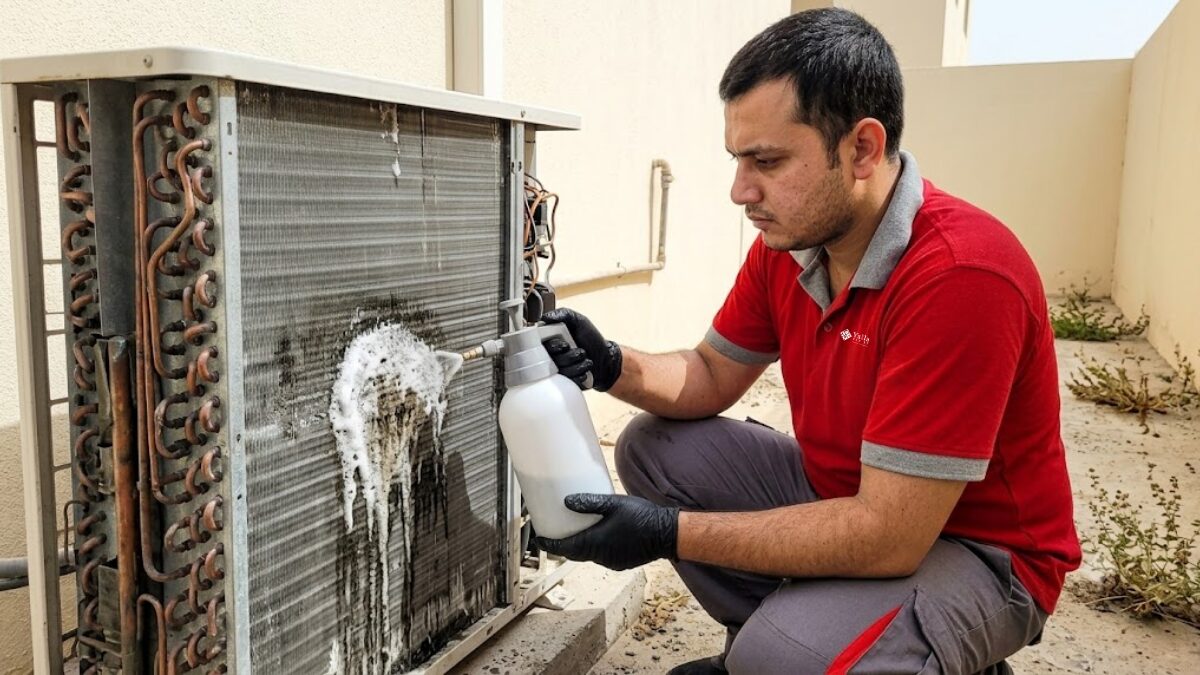
Outdoor unit powered down and tagged out. Debris and organic material removed from exterior. Non-acidic chemical cleaner applied to dissolve salt, dust, and heat-baked residue. Controlled rinse. Fin condition assessed for corrosion damage. Fan bearings and refrigerant seals inspected for wear that follows extended contamination exposure.
Post-Service Verification
Temperature differential across the evaporator measured (typically 8 to 12°C on a properly functioning system), airflow verified, and cooling output compared to baseline. If the improvement is less than expected, the service identifies whether refrigerant pressure or component condition is limiting performance beyond what cleaning alone can address.
Common Mistakes That Waste Money on Aircon Coil Cleaner Services
Understanding the mistakes clarifies why professional service matters.
Mistake One: Cleaning Only the Indoor Coil
The most common mistake is cleaning only the visible indoor unit. Owners see the evaporator side dust and assume that is the problem. Meanwhile the condenser is heavily loaded and continues to force the compressor to work harder. DEWA bill improvement is minimal.
Mistake Two: Cleaning Only the Outdoor Coil
The reverse mistake happens with technicians who focus on the visible outdoor condenser fins. Meanwhile the evaporator is loaded with mould and dust, and cooling performance remains degraded despite the outdoor cleaning.
Mistake Three: Using Wrong Chemistry
Acidic cleaners strip aluminium fin protective coating and accelerate corrosion. Water alone does not remove salt residue or grease. Household cleaners often damage the fin structure. Professional chemistry is non-acidic, coil-safe, and appropriate to the specific contamination type.
Mistake Four: Pressure Washing Grease-Contaminated Coils
Pressure washing grease-contaminated coils disperses grease deeper into the fin structure rather than removing it. This is a specific problem in Dubai restaurant-adjacent commercial AC. Chemical degreasing is the correct approach for grease contamination.
Mistake Five: Skipping Drain Pan and Line Service
Coil cleaning without drain pan servicing traps contamination in the drain system, causing overflow within weeks. Proper coil cleaning always includes drain servicing.
Mistake Six: No Post-Service Performance Verification
Without measuring temperature differential and airflow after cleaning, there is no way to verify the cleaning delivered the intended efficiency improvement. Professional service measures and documents post-clean performance.
For deeper context on how coil cleaning actually reduces DEWA bills, our guide on AC coil cleaning as the highest-impact AC service in Dubai covers the physics of heat transfer and the specific mechanics behind DEWA savings.
AC Coil Cleaner Chemistry: What Should Be Used
Professional coil cleaning chemistry is engineered for the specific job. Understanding the chemistry helps identify professional service versus generic maintenance.
Non-Acidic Cleaner Formulation
Professional coil cleaners are non-acidic. Acidic formulations strip aluminium fin protective coating over time, accelerating corrosion and shortening coil life. Non-acidic chemistry dissolves grime without damaging the coil.
Coil-Safe Surfactant Chemistry
Professional cleaners include surfactants that lift contamination without leaving residue that would attract new contamination faster after cleaning.
Dedicated Degreasing Chemistry for Grease-Contaminated Coils
Restaurant-adjacent AC systems and kitchen-facing commercial coils require dedicated degreasing chemistry rather than standard coil cleaner. This dissolves grease at the coil surface rather than dispersing it.
Bio-Sanitisation Chemistry
Post-cleaning, Dubai Municipality-approved sanitiser eliminates mould, mildew, and bacterial contamination on the coil surface and in the drain pan.
What to Avoid
Generic household cleaners, acidic industrial cleaners, and undiluted refrigerant coil cleaning products marketed for DIY use often damage AC coils rather than cleaning them. Professional cleaning chemistry protects coil life and coating integrity.
Aircon Coil Cleaner Service Cadence in Dubai
How often to book professional coil cleaning depends on property type and contamination profile.
Standard Residential Cadence
Every 4 to 6 months for continuously occupied Dubai apartments and villas. Pre-summer (November to February) is the most important cleaning window because it prepares systems for peak thermal stress.
High-Intensity Residential
Every 3 to 4 months for continuously occupied villas with 4 or more AC units, serviced apartments, and rental turnover properties.
Commercial and Industrial
Every 3 to 4 months for offices, retail, and warehousing. Every 2 to 3 months for F&B and industrial-adjacent commercial due to grease and heavy particulate loading. For hyperlocal context on industrial dust conditions, our guide on AC coil cleaning in Al Quoz and industrial dust cleaning frequency covers why warehouse and workshop properties need more frequent service.
Critical Environment
Monthly for data centers and enterprise IT rooms aligned with ISO-14644-1 standards.]
Book Professional Aircon Coil Cleaner Service in Dubai
Yalla Fix It delivers professional AC coil cleaning across Dubai, backed by 10,000+ maintenance and repair jobs completed, 95% customer satisfaction, 75+ DEWA-certified technicians, and 24/7 emergency support with a 30-minute response commitment. Our aircon coil cleaner service covers both evaporator and condenser coils, uses professional non-acidic chemistry, includes drain pan and drain line servicing, applies Dubai Municipality-approved bio-sanitisation, and delivers post-service performance verification so you know the cleaning actually improved efficiency. For structured cleaning integrated with broader maintenance across your property, an annual maintenance contract for home properties in Dubai coordinates coil cleaning with plumbing, electrical, and handyman services on a scheduled cadence. Contact us today to book professional aircon coil cleaner service for your Dubai property.
Frequently Asked Questions
What is an aircon coil cleaner and how is it different from filter cleaning?
An aircon coil cleaner service cleans the evaporator (indoor) and condenser (outdoor) coils where heat exchange actually happens. Filter cleaning removes surface debris from filter media. Coils accumulate contamination over months despite regular filter changes, and coil cleaning restores the heat-exchange efficiency that filter cleaning cannot.
Which coil is more important to clean in Dubai conditions?
Both. Evaporator coils affect cooling delivery and indoor air quality. Condenser coils affect compressor efficiency and DEWA bill. Cleaning only one when both need service delivers minimal improvement. Professional service always assesses and cleans both coils.
How do I know if my AC coils need cleaning?
Signs include: DEWA bill climbing without usage change, cooling weaker than 6 months ago, musty smell from vents, ice on copper piping or evaporator, longer AC run times, and visible dust on the vent or condenser fins.
What chemistry should professional coil cleaning use?
Non-acidic, coil-safe chemistry engineered for aluminium fin structure. Grease-contaminated coils require dedicated degreasing chemistry. Post-cleaning sanitisation should use Dubai Municipality-approved products. Household or acidic cleaners damage coils rather than cleaning them.
Can I clean AC coils myself with a DIY aircon coil cleaner?
Professional coil cleaning requires safe access to internal components, controlled drain containment, correct chemistry, and post-service performance verification. Yalla Fix It provides professional coil cleaning to protect equipment life and system warranties.
How often should Dubai AC coils be cleaned?
Every 4 to 6 months for residential, every 3 to 4 months for high-intensity residential and commercial, every 2 to 3 months for F&B and industrial-adjacent commercial. Pre-summer (November to February) is the most important annual cleaning window.
How much does professional AC coil cleaning cost in Dubai?
Cost depends on number of AC units, system type (split, ducted, cassette), and access complexity. Yalla Fix It provides a firm quote after property assessment.
How long does professional aircon coil cleaner service take?
A single split AC unit typically takes 90 to 120 minutes for complete cleaning of both evaporator and condenser coils, including drain servicing and bio-sanitisation. Full villa multi-unit cleaning can take 4 to 6 hours across all AC systems.
