Data center cleaning standards in the UAE reference a mix of international frameworks: ISO 14644 cleanroom particle-counting classes, ASHRAE TC 9.9 thermal and airflow guidelines, Uptime Institute Tier standards for facility resilience, and TIA-942 data center design. UAE-specific compliance considerations include TDRA sectoral requirements for regulated industries. No single standard defines all data center cleaning. Facility managers select and combine references based on Tier level, tenant industry requirements, and audit needs. Documented cleaning that aligns with these standards protects uptime, supports client audits, preserves equipment warranties, and demonstrates operational rigour to regulators and stakeholders.
If you manage a data center in the UAE, standard conversations come up in three contexts: audit preparation, warranty claims, and client contract negotiations. Each of these puts specific pressure on how cleaning is scoped, documented, and evidenced. There is no single UAE “data center cleaning standard” that answers every question. Instead, UAE data centers reference a mix of international standards (ISO, ASHRAE, TIA, Uptime Institute), sector-specific compliance frameworks (PCI-DSS, HIPAA, SOC 2 for hosted workloads), and UAE-specific regulatory context (TDRA data center regulations, DEWA power quality standards). This guide walks through the key standards Dubai facility managers should understand, how they interact, and where to book data center cleaning in Dubai that aligns with these frameworks.
Why Data Center Cleaning Standards Matter in the UAE
Standards are not an academic exercise. They are the language of audit, warranty, and client contract negotiation. For UAE data center facility managers, this shapes several concrete outcomes:
- Client audits and tenant contracts: many UAE data centers host workloads for banks, healthcare providers, government entities, and enterprise clients subject to their own audit chains. Documented cleaning aligned with named standards feeds these audits directly, and colocation tenants often specify cleanliness targets in master service agreements referencing ISO 14644 classes
- Equipment warranty and SLA commitments: server, storage, networking, and cooling equipment manufacturers include cleanliness expectations in warranty terms. Standards-referenced cleaning demonstrates compliance during warranty claim events, and Service Level Agreements for uptime typically require underlying operational rigour including documented cleaning
- UAE regulatory context: TDRA sectoral oversight, plus banking and healthcare regulator requirements, add UAE-specific documentation expectations layered on top of international standards. Insurance and business continuity policies may require documented preventive maintenance as covered conditions
- Peer benchmarking: understanding what standards leading Dubai data centers reference helps position your own facility against market expectations, both for client acquisition and for internal stakeholder communication
Standards give facility managers a defensible operational framework that lets cleaning providers, IT operations, and facility management use the same vocabulary during scope conversations.
ISO 14644: The Cleanroom Reference Standard
ISO 14644 is the international standard series for cleanrooms and controlled environments, published in multiple parts covering particle counting, monitoring, test methods, and specific applications.
ISO 14644-1 defines the particle-counting classes that data center cleanliness is often referenced against. The most relevant classes for Dubai data centers:
ISO Class 8
Particle concentration of 100,000 per cubic metre at ≥0.5 micron. This is a stricter target commonly written into tenant master service agreements for higher-Tier Dubai data centers, particularly those hosting regulated workloads. Achieving Class 8 typically requires monthly white-space cleaning with quarterly plenum inspection, structured personnel access controls, tacky mat protocols at every entry, and continuous filtration on cooling airflow paths. Facilities target Class 8 either because a tenant contract specifies it or because internal cleanliness policy has committed to it.
ISO Class 9
Particle concentration of 1,000,000 per cubic metre at ≥0.5 micron. This is the practical baseline that most Dubai commercial data centers operate against. A well-managed Class 9 program relies on documented daily housekeeping, weekly white-space cleaning, quarterly deeper attention to cable trays and rack tops, and annual raised-floor plenum cleaning. Class 9 does not mean loose standards, it means proportionate rigour for typical colocation and enterprise data hall risk profiles.
ISO Class 7 and Higher
Class 7 (10,000 particles per cubic metre at ≥0.5 micron) and stricter classes are occasionally referenced for enclosed high-density racks, specific enclosed vault-style zones, or dedicated hosting cages within a facility. Full-facility Class 7 is rare in Dubai commercial data centers because the cost of achieving and maintaining it typically exceeds the benefit outside specialised use cases.
Most UAE commercial data centers target ISO Class 8 or 9 for white-space particulate control. The specific class depends on facility Tier, tenant requirements, and internal cleanliness policies.
ISO 14644-2 through ISO 14644-9 cover monitoring, testing methods, and surface cleanliness. Data centers referencing ISO 14644 typically set inspection cadences and sampling methods based on these parts, particularly Part 9 for surface particulate on rack tops, cable trays, and horizontal surfaces.
Important framing on ISO 14644 and how it applies to cleaning providers:
ISO 14644 is a reference standard used across the industry to define cleanliness targets. It provides a common vocabulary: particle counting classes, monitoring frequency guidance, test methods, and surface cleanliness benchmarks that facilities, tenants, and cleaning providers all use to align on scope.
Yalla Fix It delivers data center cleaning aligned with ISO-14644-1 standards, using the tools, chemistry, inspection methods, and documentation that support facilities operating to ISO 14644 particle-counting targets. Where clients require specific documented certification requirements, these are discussed at scope definition and confirmed in writing before service begins.
ASHRAE TC 9.9: Thermal and Airflow Standards
ASHRAE TC 9.9 (Mission Critical Facilities, Technology Spaces, and Electronic Equipment) publishes thermal and airflow guidelines for data centers.
- Recommended and allowable temperature ranges: guidance on inlet air temperature for IT equipment, which shapes cooling design and cleaning implications for airflow paths
- Humidity ranges: recommended and allowable humidity, which affects both equipment reliability and cleaning approach (high humidity can create condensate risks)
- Airflow management: hot aisle / cold aisle containment principles, which cleaning work must respect to avoid disturbing designed airflow
Cleaning that ignores ASHRAE airflow design can inadvertently disrupt containment, redistribute particulates, and cause thermal issues even if the visible cleanliness result looks good. The same airflow-integrity principles apply to legacy chiller and FCU cooling infrastructure across older Dubai commercial buildings, as covered in our guide on AC maintenance in Bur Dubai and legacy chiller plant systems.
Uptime Institute Tier Standards: Facility Resilience
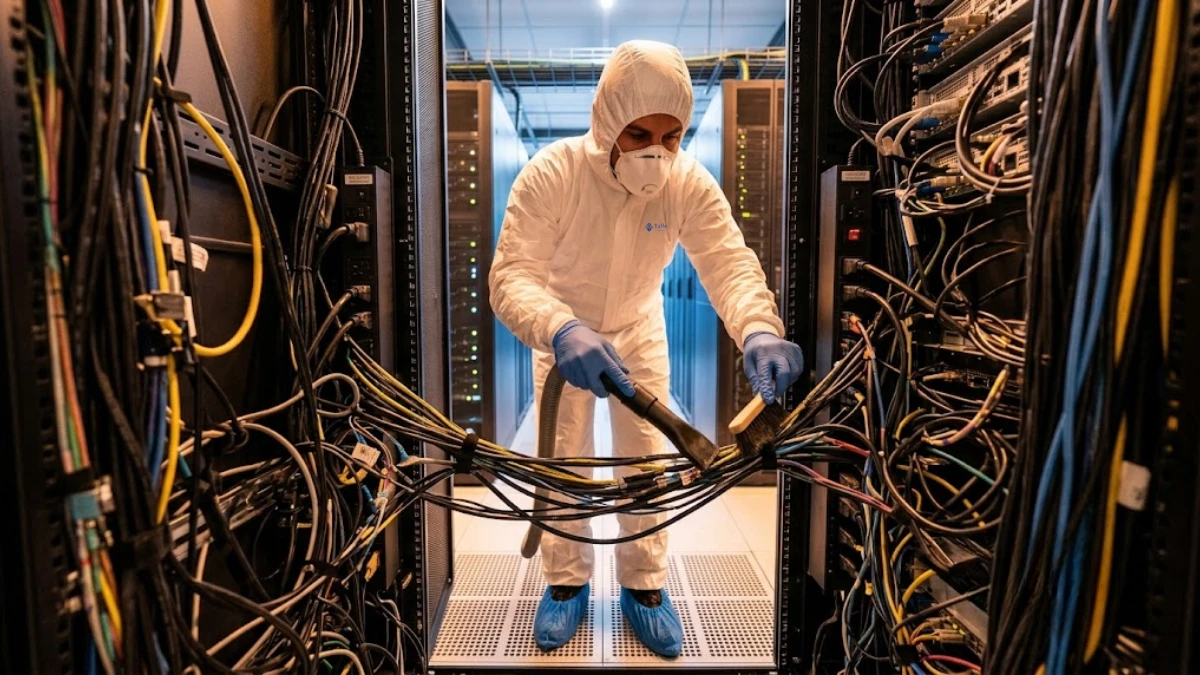
The Uptime Institute Tier classification defines data center facility resilience levels. Tiers directly shape cleaning requirements:
Tier I: Basic Capacity
The lowest resilience level, with no redundancy in cooling or power. Cleaning cadence at this Tier is typically monthly white space with annual raised-floor plenum, appropriate for edge facilities, small server rooms, and lower-criticality workloads. Documentation is usually informal but should still cover pre-work and post-work visual verification.
Tier II: Redundant Capacity
Adds partial redundancy in cooling and power. Cleaning cadence tightens because losing a single cooling unit during maintenance shouldn’t cause thermal issues, but restricted airflow from unclean systems can. Facilities at this Tier typically add quarterly attention to cable tray tops and rack tops, plus documented service records to support facility management reporting.
Tier III: Concurrently Maintainable
The most common Tier for Dubai commercial data centers. Every cooling and power path can be taken offline for maintenance without disrupting IT operations. Cleaning must therefore be schedulable during concurrent maintenance windows, and cleaning tools and methods must not disturb energised equipment. Documentation matters more here because service coordination overlaps with cooling and power maintenance events.
Tier IV: Fault Tolerant
The highest Tier, with continuous cooling and power redundancy able to survive any single failure. Cleaning cadence is the most rigorous: continuous housekeeping controls, frequent visual inspection between visits, event-triggered response (any contamination source triggers targeted cleaning), and comprehensive documentation. Class 8 cleanliness targets are common at Tier IV, driving tighter tool selection and inspection rigour.
Higher-Tier data centers typically reference higher cleanliness targets (ISO Class 8 rather than Class 9) and more frequent cleaning cadences.
TIA-942: Data Center Design Standard
TIA-942 (Telecommunications Infrastructure Standard for Data Centers) is a comprehensive standard covering data center design, including telecommunications cabling, facility layout, redundancy, and physical infrastructure.
For cleaning specifically, TIA-942: – Defines white space, gray space, and support area zoning that informs cleaning zone definitions – Includes cable pathway specifications that affect cable-tray cleaning access – References environmental controls that shape the cleaning approach to HVAC intake surfaces – Provides layout guidance that affects tile-lifting protocols for raised-floor cleaning
UAE data centers designed to TIA-942 typically have well-documented zone maps that make cleaning scope definition much more straightforward.
Sector-Specific Compliance Frameworks
UAE data centers hosting workloads for regulated industries face additional compliance frameworks. Cleaning acts as a supporting operational control across each:
PCI-DSS
The Payment Card Industry Data Security Standard applies to any facility handling, processing, or transmitting payment card data. Requirement 9 specifically covers physical access controls to systems processing cardholder data, including facility maintenance. Auditors reviewing PCI-DSS-scoped data halls look for documented visitor logs, physical access controls, and evidence that maintenance activities including cleaning happen under controlled conditions. Cleaning records with signoff and photo evidence feed the physical security control chain that auditors examine during annual assessment.
HIPAA
The Health Insurance Portability and Accountability Act applies to facilities hosting Protected Health Information (PHI). The Security Rule requires physical safeguards for facilities hosting PHI, including facility access controls, workstation security, and device controls. UAE data centers hosting healthcare data for US clients, or handling data under UAE healthcare data protection frameworks with US exposure, need documented physical facility maintenance including cleaning as part of covered physical safeguards. Facilities Managers use cleaning records alongside access logs to demonstrate that facility maintenance activities did not compromise PHI security.
SOC 2 Type II
Service Organization Control 2 audits assess how service providers manage customer data across five trust service criteria. Type II audits cover an operating period (typically 6 to 12 months), meaning consistent documented cleaning during that period matters more than a single-point-in-time snapshot. Auditors sample cleaning records to test environmental control operating effectiveness. A facility with monthly documented cleaning across the audit period passes the environmental control test procedures more easily than one relying on ad-hoc records.
ISO 27001
The international information security management system standard requires physical and environmental security controls under Annex A.11. Certified organisations must demonstrate physical facility controls including maintenance activities, cleanliness of areas holding information assets, and secure disposal. Data centers operating under ISO 27001 certified ISMS scope typically require cleaning contractors to work under approved procedures with documented outcomes, feeding the ISMS operating records reviewed at surveillance and recertification audits.
UAE Sectoral Requirements
The Telecommunications and Digital Government Regulatory Authority (TDRA), Central Bank of the UAE, Dubai Health Authority, and other UAE regulators publish sectoral requirements for data centers hosting regulated workloads. These typically reference international standards (ISO, ASHRAE, TIA) plus UAE-specific documentation and reporting requirements. Facilities hosting regulated workloads for these sectors typically need cleaning records that align with the referenced international standards and include the UAE-specific documentation format the regulator expects.
Cleaning that aligns with named standards feeds these compliance chains directly without requiring facility managers to invent facility-specific documentation. Yalla Fix It delivers documented service records that support the physical control and environmental documentation chains these frameworks require.
How Yalla Fix It Aligns With Data Center Cleaning Standards
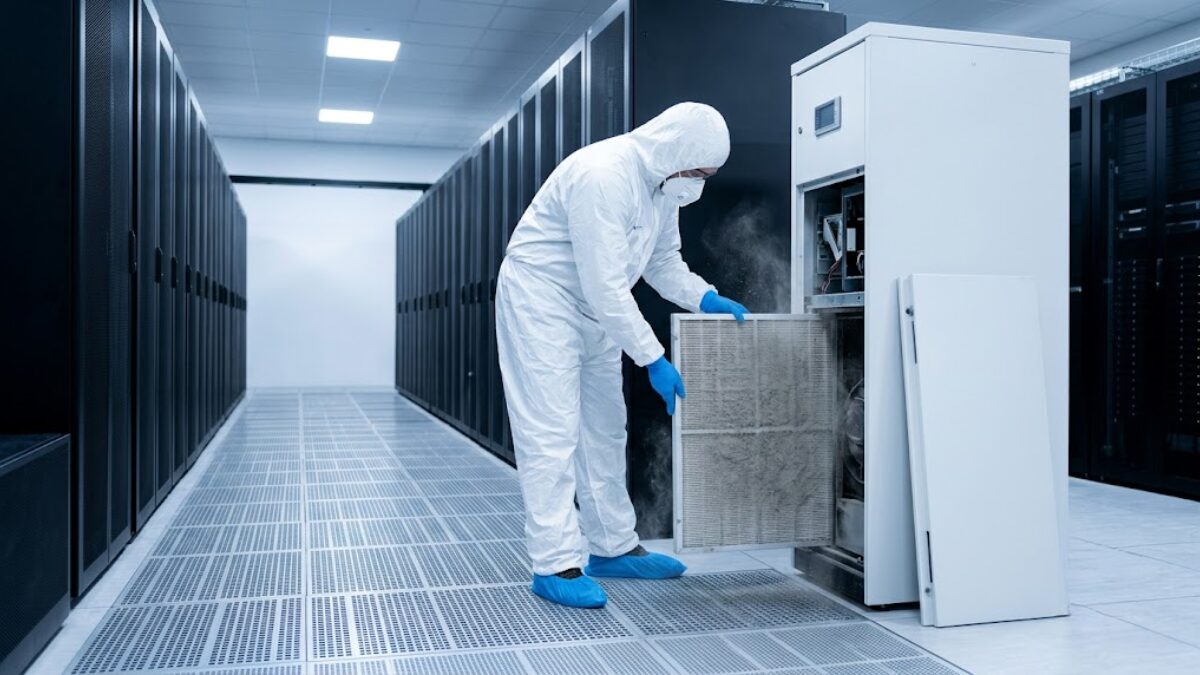
Yalla Fix It’s data center cleaning service in Dubai is delivered to align with the standards commonly referenced by UAE facility managers and their clients: ISO 14644 principles for cleanliness targets and inspection methods, ASHRAE-aware airflow that respects hot aisle / cold aisle containment, Uptime Institute Tier-appropriate cadence and rigour, TIA-942 zone recognition, and cleaning records that support PCI-DSS, HIPAA, SOC 2, and ISO 27001 audit chains. All work is delivered by DEWA-certified technicians.
Yalla Fix It delivers commercial data center cleaning services in Dubai that align with these standards without claiming certifications the company does not hold. Where clients require documented certification to specific standards, this is discussed at scope definition.
Data Center Cleaning: Commercial Services in Dubai
Yalla Fix It’s commercial data center cleaning covers:
- Commercial data centers and colocation facilities: routine cleaning aligned with ISO 14644 and TIA-942 zone definitions
- Enterprise server rooms: mid-sized IT rooms with ASHRAE-aware airflow-respecting cleaning
- Edge and network operations rooms: smaller critical-environment rooms with sector-appropriate documentation
- Post-incident and post-flood response: rapid response to prevent long-term contamination
- Post-construction commissioning cleaning: coordinated with commissioning agents and general contractors
Yalla Fix It delivers commercial data center cleaning services in Dubai covering colocation, enterprise, and edge facilities across Dubai.
What Standards-Aligned Cleaning Delivers
Data center cleaning that aligns with named standards delivers specific operational outcomes: uptime protection through documented preventive cleaning, warranty preservation with standards-referenced documentation, audit readiness through photo records and signoff aligned with named standards, client contract compliance for colocation and enterprise tenants who specify cleanliness targets, and insurance and business continuity support through documented preventive maintenance.
Dubai facility managers who want long-term protection typically combine data center cleaning with broader facility services through a commercial annual maintenance contract in Dubai coordinating critical-environment cleaning alongside HVAC and building services. For the operational document that turns standards-referenced targets into a repeatable program, our guide on the data center cleaning checklist for Dubai facility managers walks through zones, frequencies, tools, and documentation. For guidance on how these frequencies and standards drive annual cost, our guide on data center cleaning costs in Dubai covers cost drivers and budget structure.
When Standards Compliance Matters Most
Standards-aligned data center cleaning matters most in these scenarios:
- You are preparing for a client audit, third-party inspection, or facility certification (ISO 27001, SOC 2, PCI-DSS) that includes physical facility controls
- You are negotiating a colocation or enterprise tenancy with cleanliness targets in the master service agreement, or onboarding regulated-industry workloads (banking, healthcare, government)
- You have experienced equipment failure and need to demonstrate warranty compliance with cleanliness expectations
- You are benchmarking your Dubai facility against regional peers, or documenting operational rigour for insurance renewal or business continuity attestation
Yalla Fix It’s critical-environment team assesses your facility, aligns cleaning scope with the standards relevant to your compliance and client needs, delivers ESD-safe HEPA-filtered cleaning, and provides documented service records suitable for standards-referenced audits. All work is carried out by DEWA-certified technicians.
Book Standards-Aligned Data Center Cleaning in Dubai
Yalla Fix It’s Critical Environment Team delivers data center cleaning aligned with ISO-14644-1 standards, trusted by Moro, Gulf Data Hub, Khazna, McLaren, and Alemco. Our six-step framework (Expert Consultation, Custom Program Creation, Expert Precision Cleaning, Quality Assurance, Post-Delivery Report, Program Assessment) delivers standards-referenced documentation suitable for client audit chains across healthcare, finance, government, and enterprise workloads. The team brings over 20 years of Information Technology Operations expertise to critical-environment cleaning. Contact us today or book directly on WhatsApp to discuss standards-aligned data center cleaning for your Dubai facility.
Frequently Asked Questions
What is ISO 14644 and why does it matter for Dubai data centers?
ISO 14644 is the international cleanroom standard series. Data centers reference ISO 14644-1 particle-counting classes to define cleanliness targets. Most Dubai commercial data centers target ISO Class 8 or 9 for white-space particulate control.
Does Yalla Fix It follow ISO 14644 for data center cleaning?
Yes. Yalla Fix It delivers data center cleaning aligned with ISO-14644-1 standards, using ESD-safe tools, HEPA-filtered vacuums, non-conductive chemistry, and inspection methods that support facilities operating to ISO 14644 particle-counting targets. Documented service records suitable for client audit chains are provided with every engagement.
What ISO 14644 class do Dubai data centers typically target?
Most target ISO Class 8 or Class 9 for white-space particulate control. Higher-Tier facilities and specific enclosed high-density zones may target Class 7.
How does ASHRAE TC 9.9 apply to data center cleaning?
ASHRAE TC 9.9 defines temperature, humidity, and airflow management guidelines. Cleaning must respect designed airflow paths and hot aisle / cold aisle containment. Cleaning that ignores ASHRAE design can disrupt containment and cause thermal issues.
What are Uptime Institute Tier standards?
Tiers I to IV classify facility resilience. Higher-Tier facilities typically reference more rigorous cleanliness targets and cleaning cadences. Tier III and IV require cleaning that can happen without disrupting operations.
Does TIA-942 include cleaning requirements?
TIA-942 is primarily a design standard covering telecommunications cabling, facility layout, and infrastructure. It defines zoning that informs cleaning scope but does not prescribe specific cleaning methods.
How does cleaning support PCI-DSS or SOC 2 compliance?
Compliance frameworks include physical security and environmental control requirements. Documented cleaning records support these audit test procedures as an operational control.
What documentation does standards-aligned cleaning produce?
Pre-work and post-work photos, service logs with time-stamped tasks, tool and chemistry used, personnel on site, and lead-technician plus facility-manager signoff.
